

Microsoft Clarity has updated its analytics platform to separate AI citations into branded and non-branded queries. This critical distinction enables business owners to measure true AI discovery and evaluate their Generative Engine Optimization (GEO) efforts.

Common Crawl, the web dataset used to train major AI models like ChatGPT and Gemini, recently released guidelines on web visibility. Search expert Suganthan Mohanadasan has now automated these checks into a free tool, allowing business owners to verify if AI crawlers can index their sites.

The release of the 2026 top Generative Engine Optimization (GEO) agency shortlist highlights a critical shift in digital marketing: moving beyond simple SEO clicks toward direct pipeline attribution from AI search. Both B2B SaaS companies and local businesses are now investing heavily in strategies that earn explicit brand citations within platforms like ChatGPT, Perplexity, and Google AI Overviews.
Consumers are increasingly abandoning traditional search engines in favor of conversational AI tools like ChatGPT and Perplexity, making Generative Engine Optimization (GEO) essential for online visibility. Despite this fundamental shift, most regional and small business owners remain entirely unaware of the change. Proactive companies that optimize for AI answer engines today can establish a commanding market lead before competitors realize what happened.
AI search engines like ChatGPT, Gemini, and Perplexity increasingly rely on Reddit content to power recommendations and answer user queries. For local business owners, understanding this shift is critical to maintaining visibility in AI-generated search results as community forums become primary web data sources.
Publishing giant Reach PLC recently reported a dramatic 50% drop in organic Google referral traffic as search engines pivot toward zero-click AI answers. The sharp decline highlights why local businesses and marketers can no longer rely solely on traditional SEO and must quickly adapt to AI search engines like ChatGPT, Perplexity, and Google AI Overviews.

Negative online reviews and unfavorable articles don't just sit on search result pages anymore—AI engines are actively pulling them into direct answers. Protecting your business requires proactive online reputation management and strategic content suppression before generative AI cites bad press.

Many business owners fear that AI search engines like ChatGPT, Perplexity, and Google AI Overviews have rewritten the rules of digital marketing. However, search experts point out that AI search only feels completely new if your previous SEO strategy relied on shallow tactics like keyword stuffing and thin content.

Consumer search habits are rapidly shifting toward conversational tools like ChatGPT, Perplexity, and Google AI Overviews, yet traditional analytics platforms fail to track this new customer journey. This disconnect leaves brands facing a growing attribution gap as AI heavily influences purchases offline and behind the scenes. To maintain visibility, small and local businesses must shift focus from old-school click tracking toward Generative Engine Optimization (GEO) and citation building.

A new report highlights six perspectives on demand generation in AI search, revealing a shift away from measuring marketing success through website traffic alone. This change is driven by the rise of AI-driven search, where most searches end without a click. Businesses must adapt to this new landscape to remain visible and competitive.
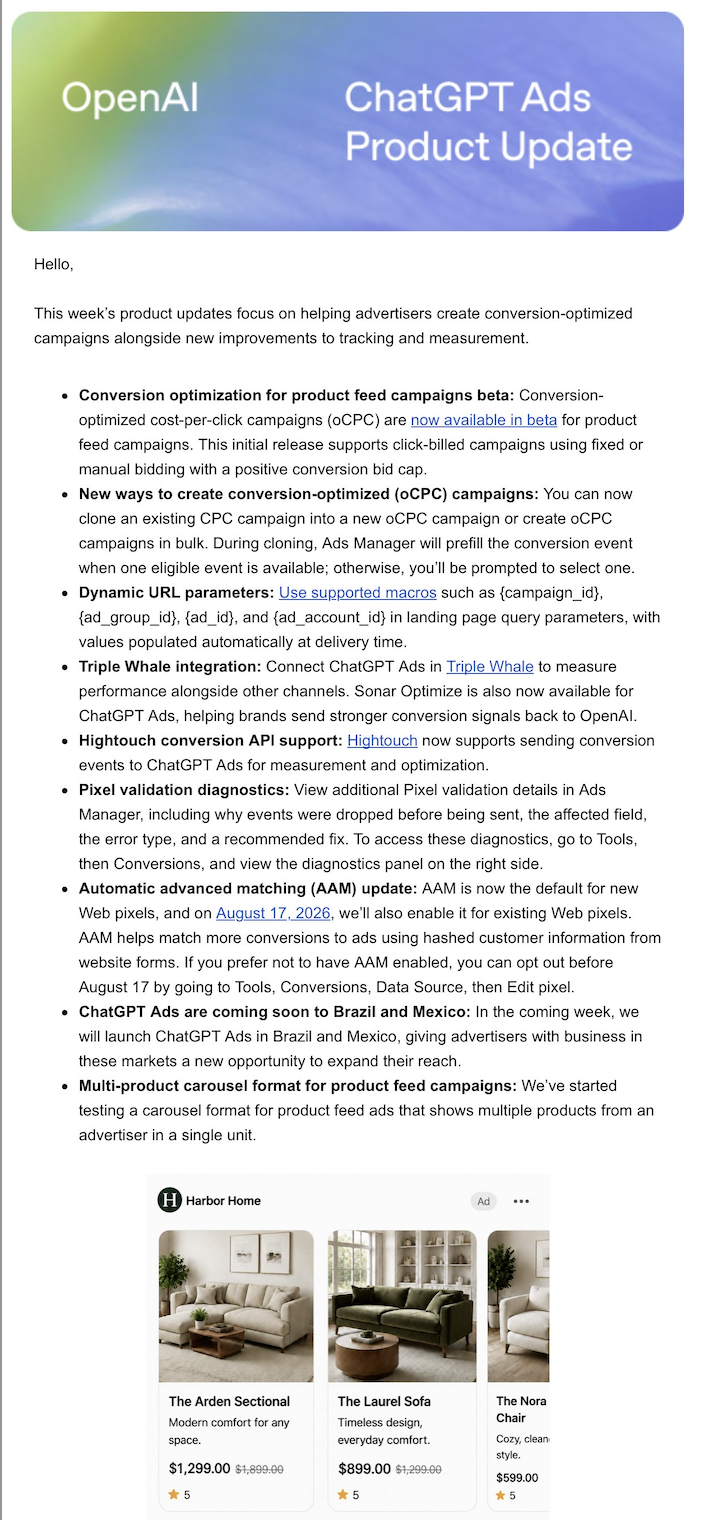
OpenAI expands ChatGPT Ads' conversion capabilities with new campaign types, measurement integrations, and optimization tools, benefiting ecommerce advertisers with improved conversion tracking, automated campaign creation, and scaled advertising.

A recent experiment revealed that AI models like ChatGPT, Claude, and Gemini provide different strategic recommendations based on the context provided. This highlights the importance of understanding the nuances of AI decision-making for businesses. By considering the context and objectives of a business, AI models can offer more tailored and effective guidance.

Google Search results are undergoing intense ranking volatility around August 5th and 6th, signaling a major unconfirmed algorithm update. Business owners are seeing sharp rank swings that impact both traditional Google rankings and AI Overview citations. Here is what small businesses need to know to protect their digital footprint.

In a paradigm shift for businesses, Search Engine Journal's study reveals that AI Overviews prioritize verified trust signals over traditional SEO rankings. To win AI recommendations, brands must establish strong digital trust signals across the open web. This means small businesses can level the playing field against industry giants by investing in trust signals.

Google's recent leadership changes, including the departure of Jeff Dean and a role change for Demis Hassabis, may significantly impact the company's AI search, Gemini, and Google Search. Business owners and marketers need to stay informed about these changes and their potential effects.

Modern searchers rarely follow a straight path to conversion, making cross-channel visibility essential. A 26-week case study published in Search Engine Land demonstrates how aligning SEO and PPC efforts eliminates friction points and builds brand authority across every buyer touchpoint.

As AI tools like ChatGPT and Claude integrate into marketing systems, concerns are growing that traditional CRMs may become obsolete. However, these AI assistants function as reasoning engines that depend on structured business data to deliver accurate recommendations, emphasizing the continued importance of a solid CRM foundation for local businesses to enhance their visibility in AI search results.
Google's latest update to its AI overviews has profound implications for publishers and brands aiming to enhance their visibility in AI search results. With top stories now featured prominently, businesses must adapt their content strategies to capitalize on this opportunity for greater discovery and citation.

As AI Overviews continue to evolve, local businesses must adapt their content strategies to remain visible in search results and AI responses. Google's integration of Top Stories into AI Overviews has significant implications for publishers and brands, requiring them to prioritize SEO and adapt to AI's content preferences. By understanding these changes, businesses can refine their marketing tactics and increase their chances of being featured in AI-generated results.

Google's limited test of a sign-in feature could significantly impact local businesses' online visibility, as users may be discouraged from accessing more search results, leading to a decrease in traffic to websites that rely on organic search.
Get the top AI-search and GEO stories in your inbox once a day, no spam.