
Google has amended its lawsuit against SerpApi, a company that provides web scraping services to businesses. This development could impact how local businesses are discovered and cited by AI tools. Learn how to adapt your SEO strategy to stay ahead.

Google's Gemini app has surpassed 1 billion monthly active users, with 63% engaging through voice interactions. This rapid uptake highlights a shift for local and small businesses away from traditional keyword searches towards conversational AI optimization.

Allegations that the popular WPForms Lite plugin added a backdoor to WordPress sites triggered widespread panic among business owners. Independent testing debunked the claims, but the situation offers crucial lessons on software security and modern AI search visibility.

Google's Gary Illyes recently clarified that hreflang alternate URLs are not indexed as standalone documents in the traditional sense. Instead, Google groups regional variants into clusters tied to a primary page, dynamically swapping URLs based on a searcher's location and language. This technical distinction carries major strategic implications for multi-regional businesses aiming to maintain visibility across both traditional search and AI answer engines.
Search forum discussions highlight major shifts in how AI search tools process local business data. With platforms like Google AI Overviews, Gemini, and Perplexity refining their citation models, local business owners need to adjust their optimization tactics to stay discoverable. Here is a breakdown of these industry changes alongside actionable steps to protect your AI search presence.

Meta is aggressively crawling the web, signaling the development of its own AI-powered search engine for Facebook, Instagram, and WhatsApp. As social and search converge, local businesses must optimize their online presence for Meta's crawlers to capture conversational AI traffic. Learn how this shift impacts Generative Engine Optimization (GEO) and your local discovery strategy.

Microsoft Clarity has updated its analytics platform to separate AI citations into branded and non-branded queries. This critical distinction enables business owners to measure true AI discovery and evaluate their Generative Engine Optimization (GEO) efforts.

Common Crawl, the web dataset used to train major AI models like ChatGPT and Gemini, recently released guidelines on web visibility. Search expert Suganthan Mohanadasan has now automated these checks into a free tool, allowing business owners to verify if AI crawlers can index their sites.

The release of the 2026 top Generative Engine Optimization (GEO) agency shortlist highlights a critical shift in digital marketing: moving beyond simple SEO clicks toward direct pipeline attribution from AI search. Both B2B SaaS companies and local businesses are now investing heavily in strategies that earn explicit brand citations within platforms like ChatGPT, Perplexity, and Google AI Overviews.
Consumers are increasingly abandoning traditional search engines in favor of conversational AI tools like ChatGPT and Perplexity, making Generative Engine Optimization (GEO) essential for online visibility. Despite this fundamental shift, most regional and small business owners remain entirely unaware of the change. Proactive companies that optimize for AI answer engines today can establish a commanding market lead before competitors realize what happened.

Negative online reviews and unfavorable articles don't just sit on search result pages anymore—AI engines are actively pulling them into direct answers. Protecting your business requires proactive online reputation management and strategic content suppression before generative AI cites bad press.

Consumer search habits are rapidly shifting toward conversational tools like ChatGPT, Perplexity, and Google AI Overviews, yet traditional analytics platforms fail to track this new customer journey. This disconnect leaves brands facing a growing attribution gap as AI heavily influences purchases offline and behind the scenes. To maintain visibility, small and local businesses must shift focus from old-school click tracking toward Generative Engine Optimization (GEO) and citation building.
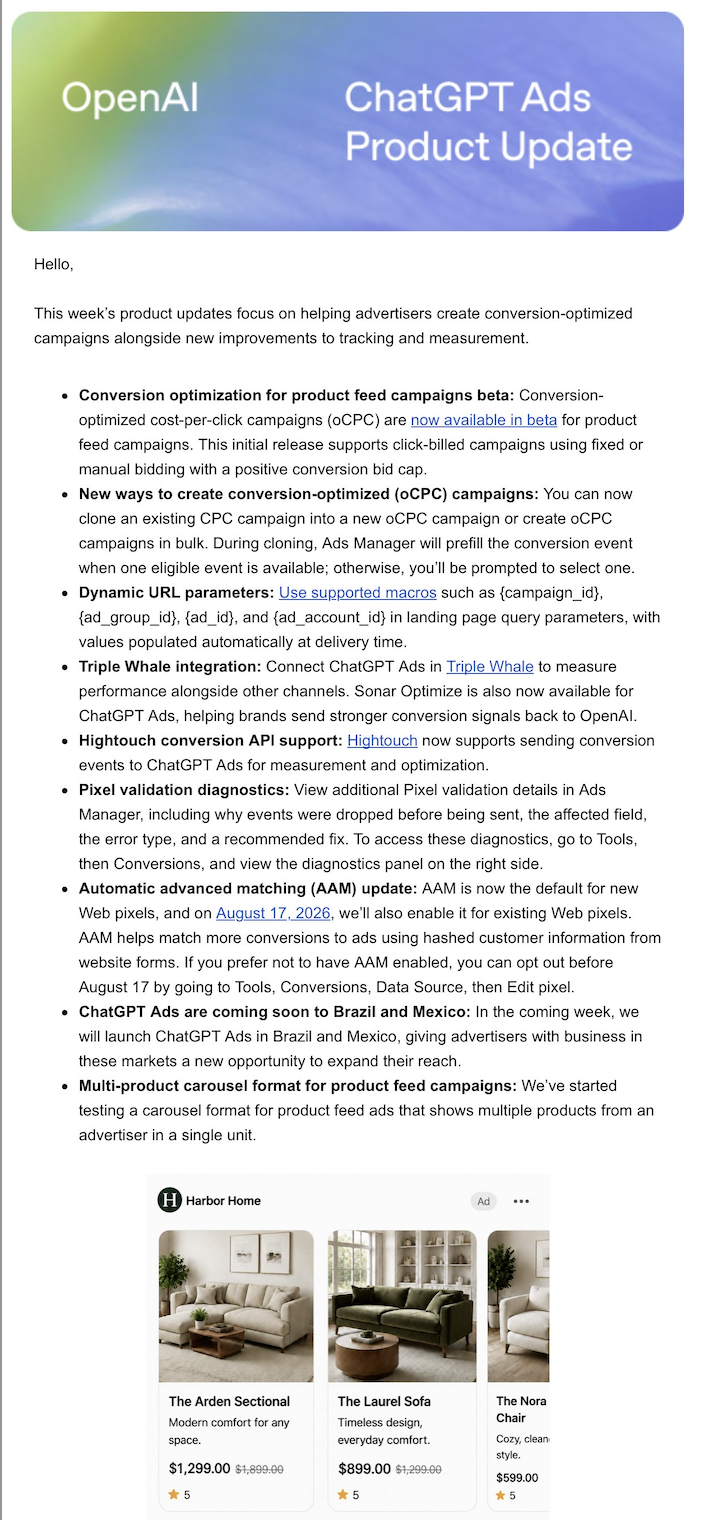
OpenAI expands ChatGPT Ads' conversion capabilities with new campaign types, measurement integrations, and optimization tools, benefiting ecommerce advertisers with improved conversion tracking, automated campaign creation, and scaled advertising.

Google Search results are undergoing intense ranking volatility around August 5th and 6th, signaling a major unconfirmed algorithm update. Business owners are seeing sharp rank swings that impact both traditional Google rankings and AI Overview citations. Here is what small businesses need to know to protect their digital footprint.

Google's recent AI image generator rollout in Google Earth was swiftly pulled after users exploited it to create fake explosions and disasters, underscoring the need for authentic brand representation and strict AI safety controls in AI search. This incident highlights the growing scrutiny around AI safety, synthetic imagery, and the importance of trust in AI-driven search engines. Local business owners must ensure their online presence is accurate and trustworthy to avoid being penalized in AI search results.

Google's refreshed crawl budget optimization guide enhances SEO strategies for business owners by emphasizing clarity and precision in its documentation, providing actionable insights to improve content visibility.

AI search engines like ChatGPT, Gemini, and Perplexity rely heavily on local listing accuracy and review sentiment to recommend local businesses. Recent data reveals that data inconsistencies across web directories can completely erase your brand from AI answers. Learn how small businesses can optimize their local signals for generative engine optimization (GEO).

In a revealing Search Engine Journal interview, search veteran Kris Jones highlights 'synthesis' as the key driver behind AI brand recommendations. Jones explains how tools like ChatGPT, Perplexity, and Google AI Overviews decide who gets recommended and how small businesses can capture those high-converting AI citations.

Google's Open Knowledge Format (OKF) v0.2 introduces a trust layer to help structure web content into clear, interconnected concepts. Although AI search agents do not actively crawl OKF bundles on websites yet, adopting this framework offers local businesses a powerful blueprint to audit and refine how AI models interpret their brand.

Snapchat is no longer recommending fully AI-generated videos in its Spotlight feed, prioritizing genuine human storytelling and original creator content instead. Driven by regulatory obligations like the EU AI Transparency Law and mounting Gen Z anxiety around synthetic media, the move signals a platform-wide turn toward authenticity. For businesses dependent on automated AI video tools, adapting visual strategies is now essential to safeguarding both social reach and AI search visibility.
Get the top AI-search and GEO stories in your inbox once a day, no spam.