

Google Search Console's generative AI performance report is now live for all users, offering insights into AI-driven search traffic and visibility to refine SEO strategies and improve online presence. This expansion aims to help businesses optimize their digital marketing efforts and stay ahead of the competition. By leveraging AI-powered search trends, businesses can gain valuable insights and adapt their strategies to drive more qualified leads and conversions.

OpenAI is currently testing a feature that adds descriptive headings to ads within ChatGPT responses. This initiative aims to enhance user experience and improve ad effectiveness, which could influence how businesses are discovered online.

Recent findings indicate that AI detection tools often misinterpret human-written content, raising concerns about their reliability and contributing to the phenomenon known as Fear of Writing (FOW). This article delves into the implications for businesses and marketers navigating the complexities of AI-generated content.

Anthropic, a prominent AI research organization, is taking a significant step to comply with the European Union's AI Act by embedding invisible watermarks in text and files produced by its AI model, Claude. This initiative aims to ensure that AI-generated content is properly attributed, which holds vital implications for businesses navigating AI search visibility.

In the age of AI, understanding decision drivers is crucial for SEOs to enhance local business visibility. This article explores essential metrics that can help businesses adapt to the changing landscape. By focusing on decision drivers, companies can improve their visibility and engagement with potential customers.

Cloudflare has introduced AI wallets and optional identity handles, extending paid access to any caller and resource, and paving the way for more efficient and secure online interactions. This innovation enables AI agents to access online resources while paying for their usage and authenticating with a unique digital identity. By leveraging these solutions, businesses can increase their online visibility and improve their search engine rankings.

OpenAI has updated its ad policies to allow some health and finance advertisers in ChatGPT, but with placement restrictions in sensitive conversations. This change impacts businesses trying to get discovered by AI search and offers new opportunities for increased visibility.

Google's Gary Illyes recently clarified that hreflang alternate URLs are not indexed as standalone documents in the traditional sense. Instead, Google groups regional variants into clusters tied to a primary page, dynamically swapping URLs based on a searcher's location and language. This technical distinction carries major strategic implications for multi-regional businesses aiming to maintain visibility across both traditional search and AI answer engines.
Search forum discussions highlight major shifts in how AI search tools process local business data. With platforms like Google AI Overviews, Gemini, and Perplexity refining their citation models, local business owners need to adjust their optimization tactics to stay discoverable. Here is a breakdown of these industry changes alongside actionable steps to protect your AI search presence.

Common Crawl, the web dataset used to train major AI models like ChatGPT and Gemini, recently released guidelines on web visibility. Search expert Suganthan Mohanadasan has now automated these checks into a free tool, allowing business owners to verify if AI crawlers can index their sites.

The release of the 2026 top Generative Engine Optimization (GEO) agency shortlist highlights a critical shift in digital marketing: moving beyond simple SEO clicks toward direct pipeline attribution from AI search. Both B2B SaaS companies and local businesses are now investing heavily in strategies that earn explicit brand citations within platforms like ChatGPT, Perplexity, and Google AI Overviews.
Consumers are increasingly abandoning traditional search engines in favor of conversational AI tools like ChatGPT and Perplexity, making Generative Engine Optimization (GEO) essential for online visibility. Despite this fundamental shift, most regional and small business owners remain entirely unaware of the change. Proactive companies that optimize for AI answer engines today can establish a commanding market lead before competitors realize what happened.

Many business owners fear that AI search engines like ChatGPT, Perplexity, and Google AI Overviews have rewritten the rules of digital marketing. However, search experts point out that AI search only feels completely new if your previous SEO strategy relied on shallow tactics like keyword stuffing and thin content.

Consumer search habits are rapidly shifting toward conversational tools like ChatGPT, Perplexity, and Google AI Overviews, yet traditional analytics platforms fail to track this new customer journey. This disconnect leaves brands facing a growing attribution gap as AI heavily influences purchases offline and behind the scenes. To maintain visibility, small and local businesses must shift focus from old-school click tracking toward Generative Engine Optimization (GEO) and citation building.
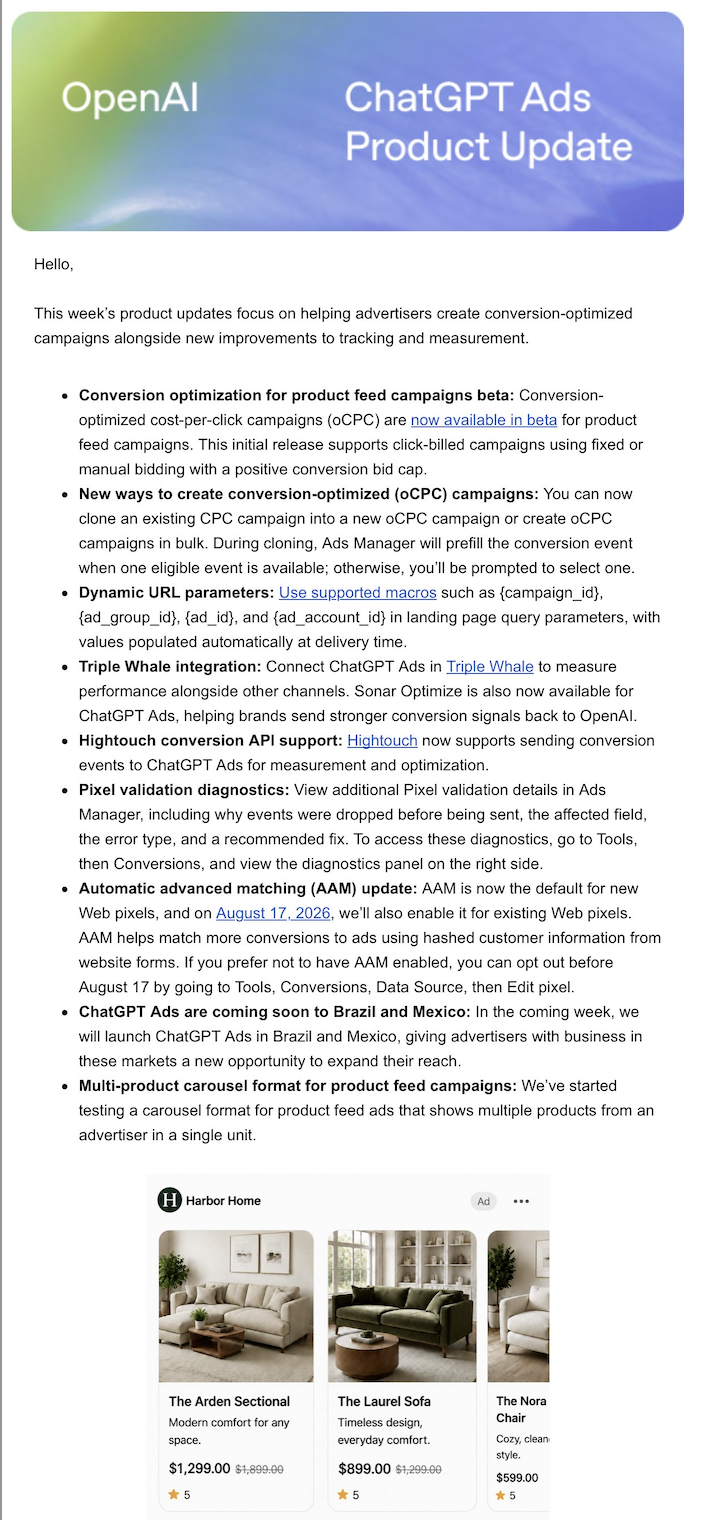
OpenAI expands ChatGPT Ads' conversion capabilities with new campaign types, measurement integrations, and optimization tools, benefiting ecommerce advertisers with improved conversion tracking, automated campaign creation, and scaled advertising.

A recent experiment revealed that AI models like ChatGPT, Claude, and Gemini provide different strategic recommendations based on the context provided. This highlights the importance of understanding the nuances of AI decision-making for businesses. By considering the context and objectives of a business, AI models can offer more tailored and effective guidance.

Google is beta testing a new Handle Swapping feature for Google Search Profiles, enabling businesses to synchronize their primary Google handle with linked, verified social accounts. This update enhances brand flexibility and strengthens entity authority in an era dominated by AI-driven search tools.

Google's recent AI image generator rollout in Google Earth was swiftly pulled after users exploited it to create fake explosions and disasters, underscoring the need for authentic brand representation and strict AI safety controls in AI search. This incident highlights the growing scrutiny around AI safety, synthetic imagery, and the importance of trust in AI-driven search engines. Local business owners must ensure their online presence is accurate and trustworthy to avoid being penalized in AI search results.

The EU's Article 50 AI Transparency Law introduces essential labeling requirements for AI-generated content. However, specific exemptions may provide strategic advantages for businesses navigating these new regulations.

AI search engines like ChatGPT, Gemini, and Perplexity rely heavily on local listing accuracy and review sentiment to recommend local businesses. Recent data reveals that data inconsistencies across web directories can completely erase your brand from AI answers. Learn how small businesses can optimize their local signals for generative engine optimization (GEO).
Get the top AI-search and GEO stories in your inbox once a day, no spam.