
Google has amended its lawsuit against SerpApi, a company that provides web scraping services to businesses. This development could impact how local businesses are discovered and cited by AI tools. Learn how to adapt your SEO strategy to stay ahead.

Google Search Console's generative AI performance report is now live for all users, offering insights into AI-driven search traffic and visibility to refine SEO strategies and improve online presence. This expansion aims to help businesses optimize their digital marketing efforts and stay ahead of the competition. By leveraging AI-powered search trends, businesses can gain valuable insights and adapt their strategies to drive more qualified leads and conversions.

TransUnion's AI research reveals significant blind spots in AI search engines, mirroring gaps in traditional SEO measurement, which affects small businesses and local enterprises.

Google has revised its lawsuit against SerpAPI, placing a stronger emphasis on the protection of licensed content. This development is crucial for businesses aiming to enhance their visibility in AI-driven search results.

Many businesses face declining organic traffic, but effective strategies can maintain client confidence by focusing on AI visibility metrics.

Anthropic, a prominent AI research organization, is taking a significant step to comply with the European Union's AI Act by embedding invisible watermarks in text and files produced by its AI model, Claude. This initiative aims to ensure that AI-generated content is properly attributed, which holds vital implications for businesses navigating AI search visibility.

In the age of AI, understanding decision drivers is crucial for SEOs to enhance local business visibility. This article explores essential metrics that can help businesses adapt to the changing landscape. By focusing on decision drivers, companies can improve their visibility and engagement with potential customers.

Cloudflare has introduced AI wallets and optional identity handles, extending paid access to any caller and resource, and paving the way for more efficient and secure online interactions. This innovation enables AI agents to access online resources while paying for their usage and authenticating with a unique digital identity. By leveraging these solutions, businesses can increase their online visibility and improve their search engine rankings.

OpenAI has updated its ad policies to allow some health and finance advertisers in ChatGPT, but with placement restrictions in sensitive conversations. This change impacts businesses trying to get discovered by AI search and offers new opportunities for increased visibility.

Allegations that the popular WPForms Lite plugin added a backdoor to WordPress sites triggered widespread panic among business owners. Independent testing debunked the claims, but the situation offers crucial lessons on software security and modern AI search visibility.

Google's Gary Illyes recently clarified that hreflang alternate URLs are not indexed as standalone documents in the traditional sense. Instead, Google groups regional variants into clusters tied to a primary page, dynamically swapping URLs based on a searcher's location and language. This technical distinction carries major strategic implications for multi-regional businesses aiming to maintain visibility across both traditional search and AI answer engines.

Microsoft Clarity has updated its analytics platform to separate AI citations into branded and non-branded queries. This critical distinction enables business owners to measure true AI discovery and evaluate their Generative Engine Optimization (GEO) efforts.

Common Crawl, the web dataset used to train major AI models like ChatGPT and Gemini, recently released guidelines on web visibility. Search expert Suganthan Mohanadasan has now automated these checks into a free tool, allowing business owners to verify if AI crawlers can index their sites.

Consumers are increasingly abandoning traditional search engines in favor of conversational AI tools like ChatGPT and Perplexity, making Generative Engine Optimization (GEO) essential for online visibility. Despite this fundamental shift, most regional and small business owners remain entirely unaware of the change. Proactive companies that optimize for AI answer engines today can establish a commanding market lead before competitors realize what happened.

Consumer search habits are rapidly shifting toward conversational tools like ChatGPT, Perplexity, and Google AI Overviews, yet traditional analytics platforms fail to track this new customer journey. This disconnect leaves brands facing a growing attribution gap as AI heavily influences purchases offline and behind the scenes. To maintain visibility, small and local businesses must shift focus from old-school click tracking toward Generative Engine Optimization (GEO) and citation building.
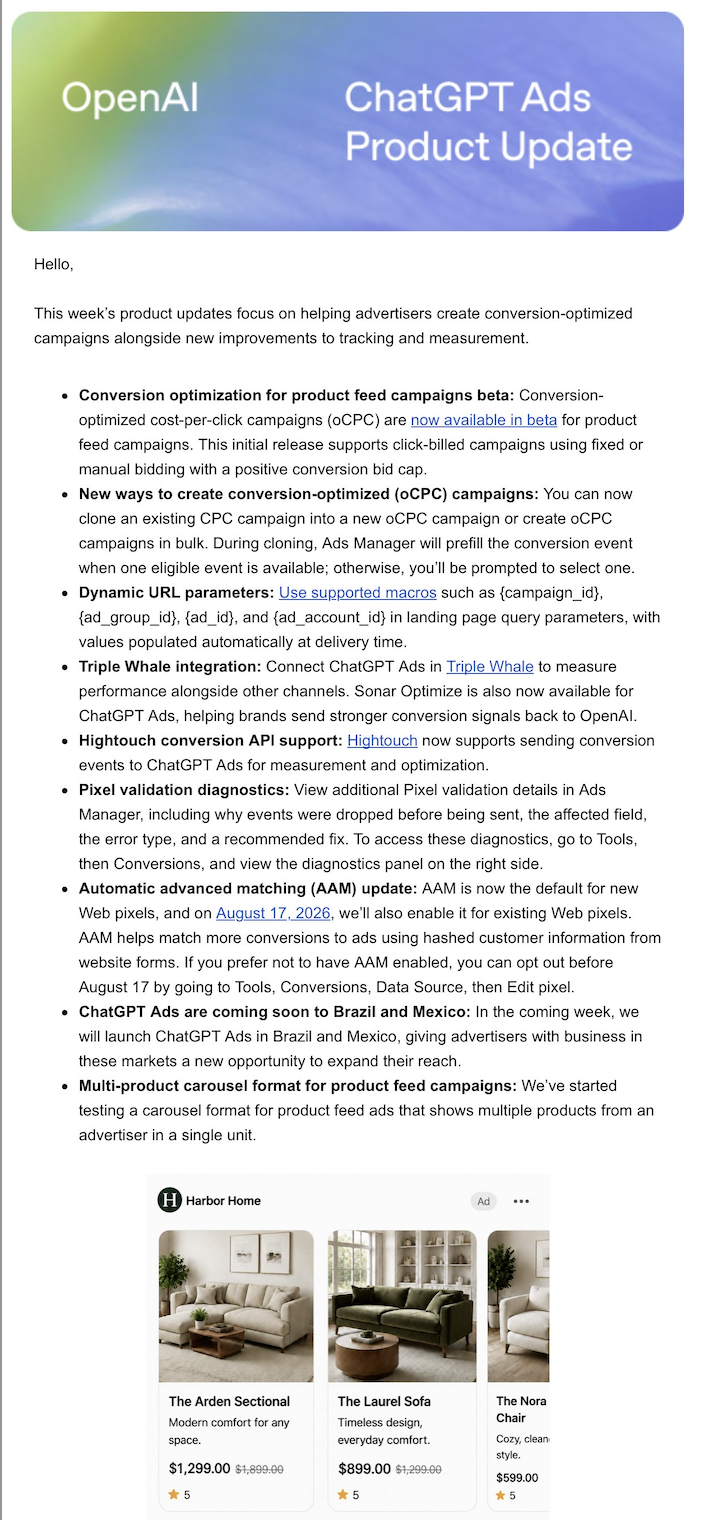
OpenAI expands ChatGPT Ads' conversion capabilities with new campaign types, measurement integrations, and optimization tools, benefiting ecommerce advertisers with improved conversion tracking, automated campaign creation, and scaled advertising.

A recent experiment revealed that AI models like ChatGPT, Claude, and Gemini provide different strategic recommendations based on the context provided. This highlights the importance of understanding the nuances of AI decision-making for businesses. By considering the context and objectives of a business, AI models can offer more tailored and effective guidance.

Google Search results are undergoing intense ranking volatility around August 5th and 6th, signaling a major unconfirmed algorithm update. Business owners are seeing sharp rank swings that impact both traditional Google rankings and AI Overview citations. Here is what small businesses need to know to protect their digital footprint.

As AI tools like ChatGPT and Claude integrate into marketing systems, concerns are growing that traditional CRMs may become obsolete. However, these AI assistants function as reasoning engines that depend on structured business data to deliver accurate recommendations, emphasizing the continued importance of a solid CRM foundation for local businesses to enhance their visibility in AI search results.

Google's limited test of a sign-in feature could significantly impact local businesses' online visibility, as users may be discouraged from accessing more search results, leading to a decrease in traffic to websites that rely on organic search.
Get the top AI-search and GEO stories in your inbox once a day, no spam.