
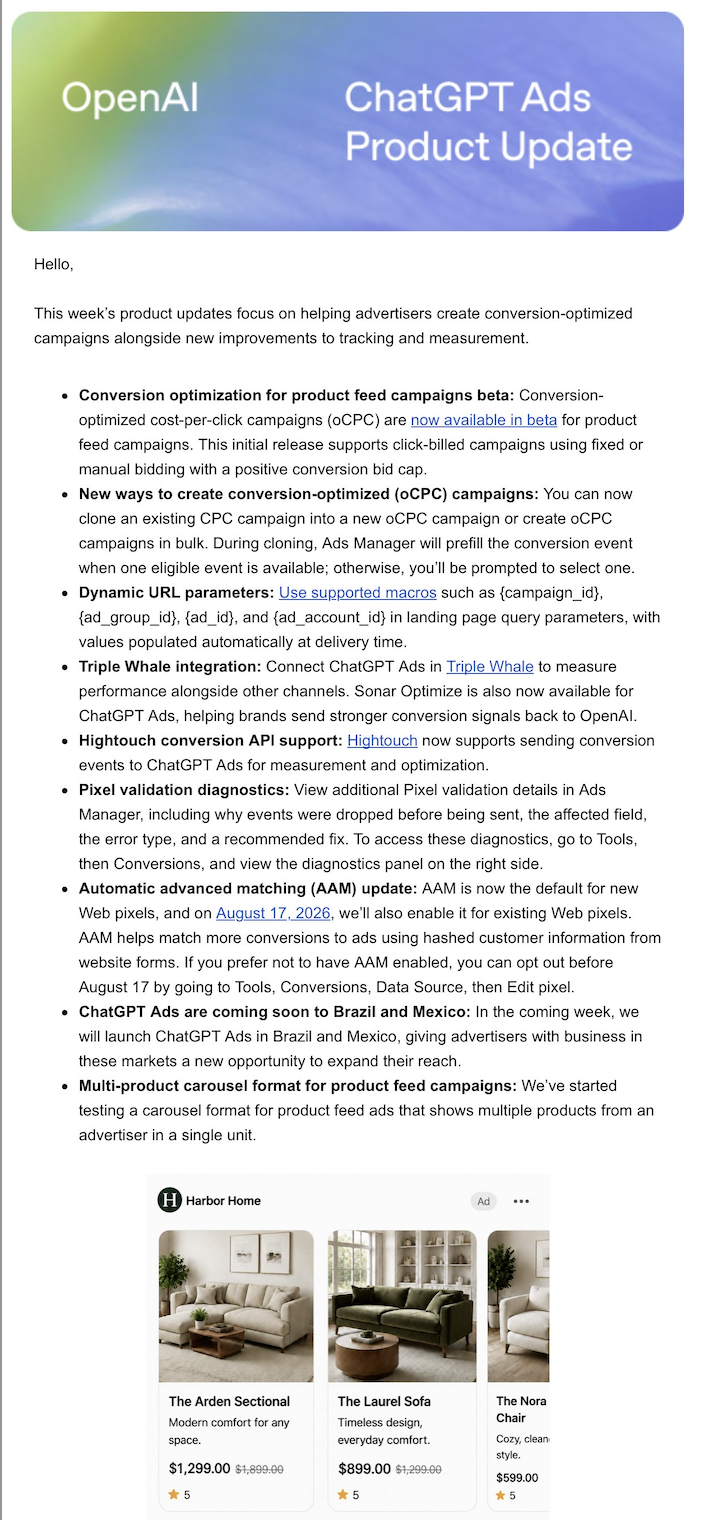
OpenAI expands ChatGPT Ads' conversion capabilities with new campaign types, measurement integrations, and optimization tools, benefiting ecommerce advertisers with improved conversion tracking, automated campaign creation, and scaled advertising.

A recent experiment revealed that AI models like ChatGPT, Claude, and Gemini provide different strategic recommendations based on the context provided. This highlights the importance of understanding the nuances of AI decision-making for businesses. By considering the context and objectives of a business, AI models can offer more tailored and effective guidance.

As AI tools like ChatGPT and Claude integrate into marketing systems, concerns are growing that traditional CRMs may become obsolete. However, these AI assistants function as reasoning engines that depend on structured business data to deliver accurate recommendations, emphasizing the continued importance of a solid CRM foundation for local businesses to enhance their visibility in AI search results.

Recent research reveals that ChatGPT and other leading AI platforms populate product recommendation carousels directly from Google Merchant Center feeds rather than scraping traditional web pages. With up to 83% of AI product recommendations mirroring top Google Shopping organic results, feed optimization has quickly become the primary battlefield for AI visibility. For e-commerce brands and local retailers, feed quality now determines whether your products get recommended—or overlooked.

OpenAI is experimenting with a new ChatGPT advertising format that replaces traditional destination websites with conversational AI agents tailored to each business, potentially revolutionizing the way businesses interact with customers online.
As buyers trade traditional Google searches for conversational tools like ChatGPT and Perplexity, businesses face a new optimization challenge. Search experts at Bodhium Labs warn that mass-producing low-quality AI content will only damage existing search rankings, offering practical strategies to earn AI citations while protecting hard-won Google SEO authority.

A new study from Writesonic reveals that roughly 40% of AI search citations fail to mention the source brand in their generated text. This phenomenon—dubbed 'ghost citations'—varies significantly across platforms, affecting engines like Perplexity, Google AI Mode, and ChatGPT. Consequently, tracking citation counts alone no longer provides business owners with an accurate picture of actual brand visibility.

AI tools such as ChatGPT, Gemini, and Google AI Overviews increasingly rely on creator content and third-party media to answer subjective search queries. With research showing that 82% of AI citations point to external sources rather than brand websites, managing influencer partnerships and customer review channels has become essential for modern search visibility.

ChatGPT Ads has introduced several new tools aimed at improving advertising performance, conversion optimization, and campaign management. These updates bring ChatGPT Ads closer to the level of more mature ad platforms.

As AI search continues to rise, businesses are being asked if their clients appear in AI-driven search platforms like ChatGPT. In this article, we'll explore the demand for AI search visibility, the challenges agencies face in measuring it, and what's trackable today.

Yelp's partnership with OpenAI is set to revolutionize local search by integrating Yelp content into ChatGPT searches, making it easier for users to find and interact with local businesses. This integration will give users access to real-time local recommendation data, increasing the competition for online visibility. As a business owner, it's crucial to stay ahead of the curve and optimize your online presence to take advantage of this new development.

A recent Semrush analysis reveals that only 15.2% of ChatGPT topic categories have a clear brand owner, challenging the effectiveness of SEO alone in determining topic ownership.

A recent study by João da Silva and a VisibilityAI researcher reveals that framing your brand's category correctly can significantly impact its visibility on AI-powered search engines like ChatGPT and Google AI Overviews. The study tested 12 athletic apparel brands in the U.K. under two different category framings: athleisure and athletic footwear. By optimizing category framing, businesses can increase their chances of being recommended by AI search engines.

Discover how a local GEO baseline audit can help your business get discovered by AI search tools like ChatGPT, Perplexity, and Gemini. Learn how to run an audit and improve your online visibility. Get found by AI and increase your customer base.

OpenAI's ambitious ad revenue forecast for ChatGPT may fall short by $90 billion, according to a recent report from Emarketer. This has significant implications for businesses looking to tap into the growing AI search market.
Get the top AI-search and GEO stories in your inbox once a day, no spam.