
Home / News / Perplexity Beats ChatGPT on Source Credibility
Perplexity Beats ChatGPT on Source Credibility
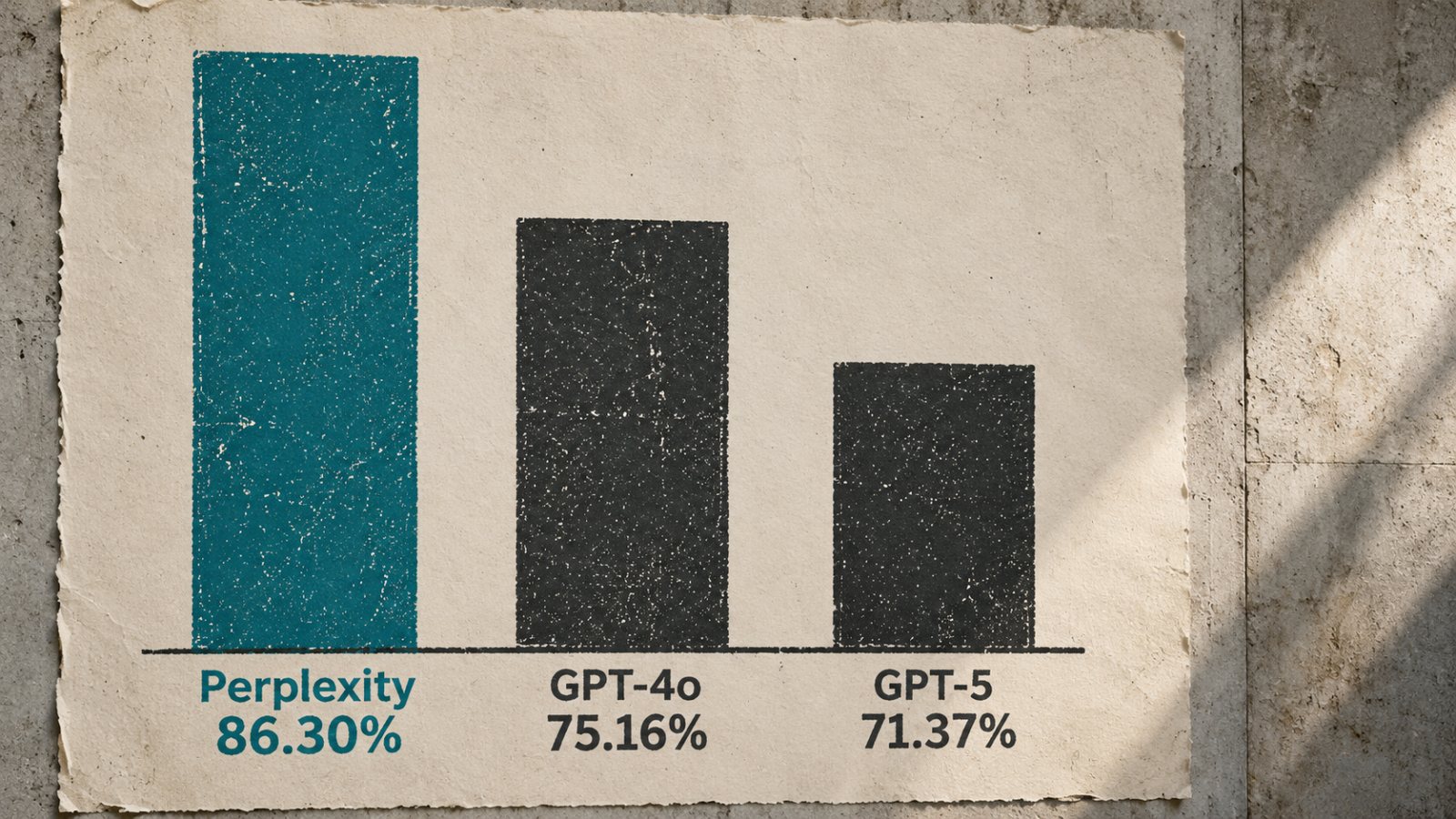
A new EACL study shows Perplexity outperforms ChatGPT in citing credible open‑web sources, a finding that shifts the focus for businesses looking to rank in AI‑first search. The evaluation—testing 100 claims across five high‑misinformation topics—gave Perplexity an 86.30 % credibility score versus 75.16 % for GPT‑4o and 71.37 % for GPT‑5. Business owners must now prioritize high‑authority citations to stay visible in the next generation of AI‑driven discovery.
Key Highlights
- ✓Perplexity leads ChatGPT in source credibility by over 11 percentage points (86.30% vs 75.16%)
- ✓The study focused on 'misinformation-prone' topics like politics, health, and climate
- ✓ChatGPT deep research remains superior for restricted, source-defined workflows
- ✓Businesses must optimize for high-authority citations to be found by Perplexity
What Happened: The Great AI Credibility Showdown
The world of AI search has just been rewritten. A recent evaluation by the European Chapter of the Association for Computational Linguistics (EACL) pitted the leading AI assistants against one another, measuring how reliably they cite credible sources. The findings were clear: Perplexity has officially dethroned ChatGPT as the top performer in open‑web source credibility.
October 8, 2026 at 03:00 AM | Author: [QUASA Editorial Team](https://quasa.io/team#editorial-team) | 6 min read | 5
Published on October 8, 2026, the study examined 100 claims across five misinformation‑prone topics—health, climate change, politics, economics, and technology. While GPT‑5 and GPT‑4o have long been the industry benchmarks, Perplexity’s average credibility score of 86.30 % eclipses ChatGPT’s 75.16 % and 71.37 % respectively.
For a researcher this is a useful metric, but for a business owner it is a strategic signal. In the age of AI‑driven discovery, the trustworthiness of the sources an assistant pulls determines whether your business appears in the results that matter most.
Why It Matters: Why This Matters for Your Business Visibility
When customers ask open‑ended questions—“best local plumbing services” or “top‑rated eco‑friendly cleaning products”—they rely on AI assistants to surface the most credible answers. Perplexity’s superior source filtering means it favors high‑authority, well‑verified sites, and will ignore low‑quality blogs or unverified directories. If your business only shows up on a niche forum or a generic listing, Perplexity may simply skip it, leaving your brand invisible in the AI‑first search experience.
Contrast that with ChatGPT’s Deep Research mode, which excels when the user supplies a curated list of trusted domains. For a company that wants to ensure every answer references its own official website, Deep Research can enforce that boundary. Yet for most customers who begin with a broad query, Perplexity’s discovery‑oriented approach dominates.
The practical takeaway is simple: visibility no longer hinges solely on content volume; it hinges on where that content resides. To stay competitive, businesses must:
- Secure placements on high‑authority domains—major news outlets, industry journals, and reputable directories.
- Optimize metadata and schema so that search engines—and by extension AI assistants—recognize your site as a trusted source.
- Monitor AI‑search performance and adjust your content strategy to align with the evolving credibility preferences of assistants like Perplexity.
By aligning your online footprint with the criteria that AI assistants reward, you position your brand for the next wave of search visibility.
Why This Matters For Your Business
When customers pose open‑ended queries, AI assistants decide which sites earn the spotlight. Perplexity’s evaluation shows it leans heavily toward high‑authority, well‑verified sources, meaning businesses that exist only on low‑trust blogs or generic directories risk disappearing from the results that drive traffic. In contrast, ChatGPT’s Deep Research mode is valuable when users provide a curated list of trusted domains, but most customers start with a broad question. Therefore, the key to AI‑search success is not just publishing content—it’s ensuring that content lives on domains that the AI considers credible. By securing citations on reputable news sites, industry journals, and recognized directories, businesses can guarantee that their information is not only seen but also trusted by the AI that powers modern discovery.
Frequently Asked Questions
Which AI tool is better for finding credible sources?
Perplexity currently holds the edge in open‑web source credibility, with an 86.30 % rating compared to ChatGPT's 75.16 % in recent EACL evaluations.
Should my business focus on Perplexity or ChatGPT SEO?
You should optimize for both, but prioritize high‑authority citations. Perplexity is better at discovering new sources, while ChatGPT is better when users have specific boundaries. Ensuring your business is on credible platforms helps you rank in both.
What is 'Deep Research' in ChatGPT?
Deep Research is OpenAI’s mode that allows users to restrict search to specific approved websites or domains, making it ideal for tasks that require strict source control.
How do I get cited by these AI tools?
The key is to appear on authoritative, high‑trust domains. Being listed on major news sites, research publications, or reputable industry directories increases your chances of being cited as a credible source by Perplexity.
Is your business showing up in AI search?
Get your free AI visibility audit - see if ChatGPT, Perplexity, and Google AI actually recommend you.