
Home / News / New Studies Show AI Search Traffic Too Low to Justify Investment
New Studies Show AI Search Traffic Too Low to Justify Investment
Three recent studies show that AI‑driven search tools such as ChatGPT, Perplexity and Gemini generate only a tiny fraction of the traffic and conversions that Google organic search delivers. For small‑business owners, the findings argue for refocusing on proven SEO tactics rather than betting on AI visibility.
Key Highlights
- ✓AI search delivers less than 1% of Google organic traffic.
- ✓Conversion rates from AI referrals are ten times lower than Google.
- ✓All three studies agree AI visibility is a distraction for most sites.
- ✓Prioritise Google SEO; treat AI as a supplemental, low‑budget tactic.
What Happened
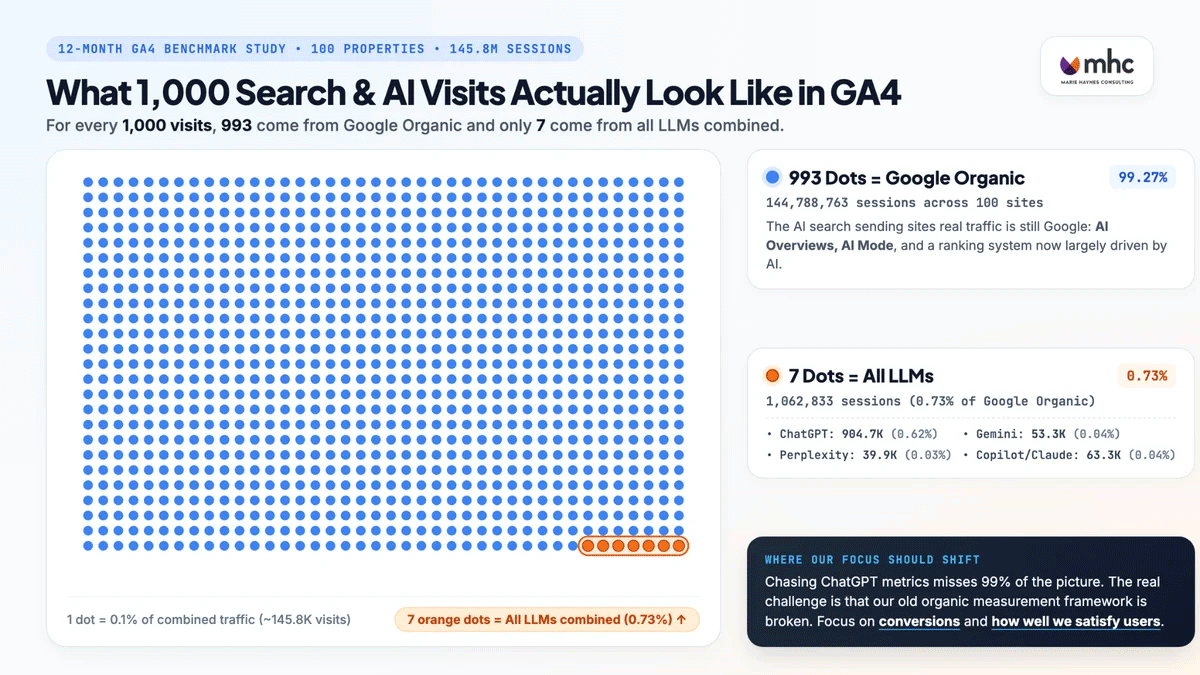
In the past week three independent research projects hit the headlines with a common, unsettling conclusion: AI‑search visibility is not a revenue driver for most sites. The studies—by Marie Haynes, SEO Works, and Kevin Indig—examined hundreds of websites, millions of sessions, and real‑world referral traffic from AI assistants such as ChatGPT, Perplexity, Gemini, and Google AI Overviews. Across the board, AI‑generated results accounted for well under 1 % of the traffic that Google organic search provides.
Key Details
- Marie Haynes analyzed 12 months of GA4 data from 100 sites (over 145 million sessions). ChatGPT referrals made up only 0.62 % of the volume driven by Google organic.
- SEO Works released a benchmark report that tracked AI‑referral traffic for dozens of e‑commerce and service‑based sites. The average conversion rate from AI referrals was 0.3 %, compared with 3 % from traditional organic search.
- Kevin Indig compared AI‑driven traffic to direct traffic growth over a 9‑month period. He found AI referrals contributed no measurable lift in direct‑traffic metrics, suggesting they do not create brand‑building momentum.
All three studies agree on one point: AI search is a distraction, not a primary acquisition channel. While AI assistants can surface answers quickly, they rarely send users to the original source, and when they do, the visitors are less likely to convert.
What It Means For Your Business
1. Keep Google SEO Front‑and‑Center
The data reaffirm that Google organic search remains the king of traffic. Investing in keyword research, high‑quality content, and technical SEO will still deliver the biggest ROI for local and small businesses.
2. Treat AI Visibility as a Supplemental Tactic
If you have bandwidth, consider modest AI‑optimisation—structured data, concise answers, and clear brand signals—so that when an AI model does surface your site, it looks authoritative. But don’t allocate a major budget to AI‑only campaigns.
3. Focus on Conversions, Not Just Clicks
The studies show AI referrals convert at a fraction of the rate of Google clicks. Prioritise landing‑page optimization, clear calls‑to‑action, and local schema markup to capture the higher‑value traffic that does arrive.
4. Monitor Your Own Data
Every business is unique. Use Google Analytics 4 or similar tools to track AI‑referral traffic (often labeled as chatgpt.com, perplexity.ai, etc.). If you notice a spike that translates into leads, you can adjust your strategy accordingly.
Practical Steps for Small Business Owners
- Audit your site for structured data (FAQ, How‑To, LocalBusiness schema). This increases the chance an AI assistant will pull your content as a concise answer.
- Maintain a robust Google Business Profile. AI tools often pull from Google Maps and Business Profiles for local queries.
- Create “Answer‑Friendly” content: short paragraphs, bullet points, and clear headings that AI models can easily parse.
- Allocate 80 % of your SEO budget to classic Google tactics and the remaining 20 % to experimental AI‑visibility work.
- Set up alerts in GA4 for traffic sources that contain
chatgpt,perplexity,gemini, orbardto keep tabs on any emerging trends.
Bottom Line
While the hype around AI‑search is loud, the hard numbers say the same thing we’ve known for years: Google still drives the lion’s share of discoverability and sales. Treat AI visibility as a complementary channel, not the main stage.
---
Key Takeaway: Invest where the traffic and conversions are proven—Google SEO—while keeping an eye on AI trends without over‑committing resources.
Why It Matters
For businesses that depend on online discovery, AI assistants can feel like a new gold rush. The three independent studies, however, reveal that the gold is thin: AI‑driven referrals generate only a fraction of the traffic and conversions that Google provides. Diverting significant time, money, or staff to chase AI‑only visibility risks neglecting the proven engine that fuels most of your leads.
Moreover, AI tools are still maturing. Their algorithms typically extract answers from existing web content and rarely route users back to the source. Until AI models start delivering traffic more reliably, the safest bet for small businesses is to double‑down on Google SEO while experimenting modestly with AI‑friendly content. This balanced approach keeps you visible where customers actually search, and positions you to capitalize on any future shift toward AI‑driven discovery.
FAQs
[{"question":"Should I stop all AI‑search optimisation?","answer":"No. Implement low‑cost tactics like schema markup and concise FAQs, but keep the majority of your budget on Google SEO."},{"question":"How can I track AI‑referral traffic?","answer":"In GA4, look for source/medium entries that contain chatgpt, perplexity, gemini, or bard. Create a custom report to monitor volume and conversion."},{"question":"Will AI search become more important in the future?","answer":"Possibly, but the current evidence shows it’s a minor channel. Keep an eye on trends, but base your core strategy on proven search sources."}]
Why This Matters For Your Business
For businesses that depend on online discovery, AI assistants can feel like a new gold rush. The three independent studies, however, reveal that the gold is thin: AI‑driven referrals generate only a fraction of the traffic and conversions that Google provides. Diverting significant time, money, or staff to chase AI‑only visibility risks neglecting the proven engine that fuels most of your leads. Moreover, AI tools are still maturing. Their algorithms typically extract answers from existing web content and rarely route users back to the source. Until AI models start delivering traffic more reliably, the safest bet for small businesses is to **double‑down on Google SEO** while experimenting modestly with AI‑friendly content. This balanced approach keeps you visible where customers actually search, and positions you to capitalize on any future shift toward AI‑driven discovery.
Frequently Asked Questions
Should I stop all AI‑search optimisation?
No. Implement low‑cost tactics like schema markup and concise FAQs, but keep the majority of your budget on Google SEO.
How can I track AI‑referral traffic?
In GA4, look for source/medium entries that contain `chatgpt`, `perplexity`, `gemini`, or `bard`. Create a custom report to monitor volume and conversion.
Will AI search become more important in the future?
Possibly, but the current evidence shows it’s a minor channel. Keep an eye on trends, but base your core strategy on proven search sources.
Is your business showing up in AI search?
Get your free AI visibility audit - see if ChatGPT, Perplexity, and Google AI actually recommend you.