
Home / News / Google Business Profiles: 4‑Day Window to Reject User Edits
Google Business Profiles: 4‑Day Window to Reject User Edits
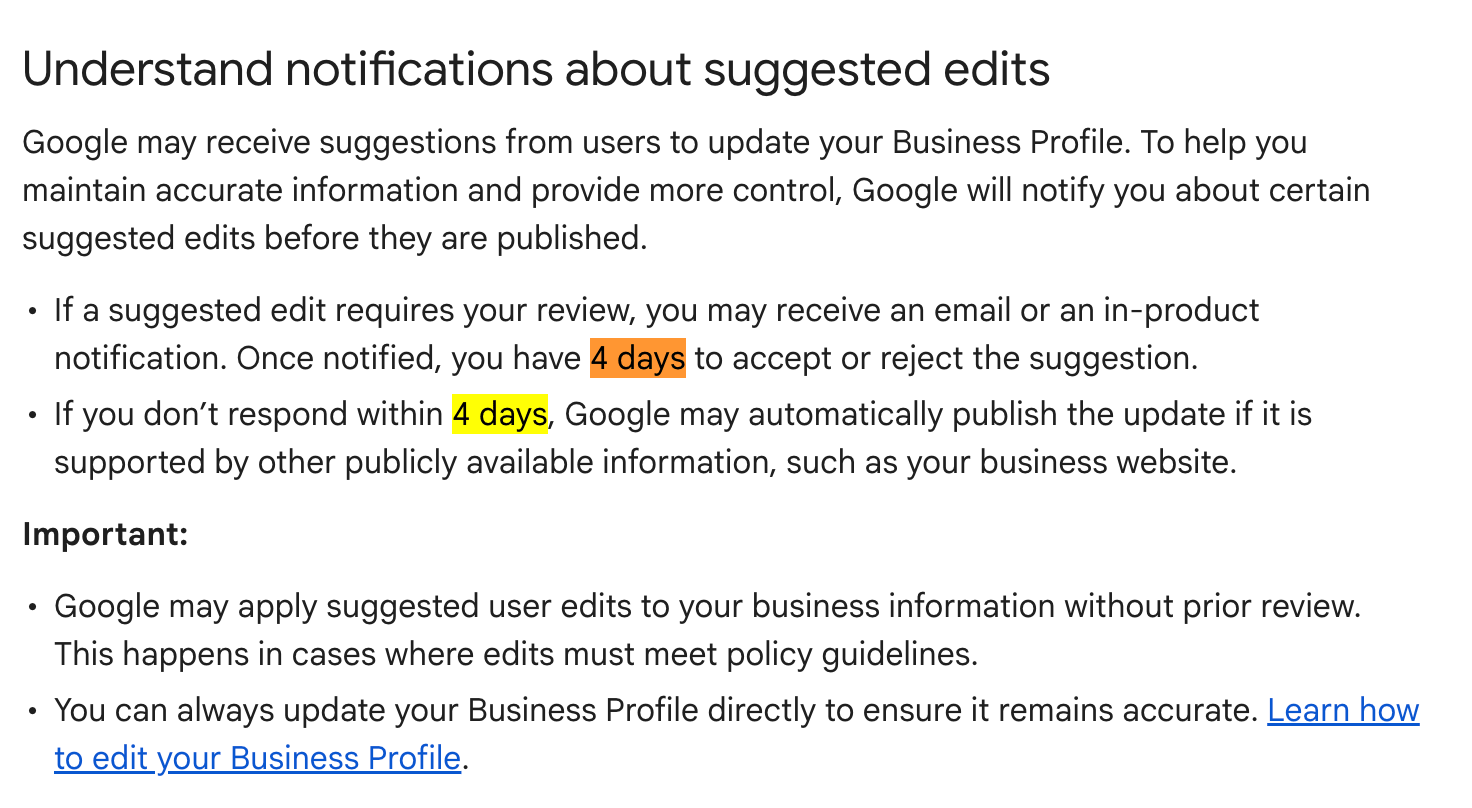
Google has introduced a four‑day window for Business Profile owners to accept or reject user‑suggested edits. If the owner does not act within 96 hours, Google may automatically apply the change when it matches publicly available data. This shift gives local businesses a clearer timeline for protecting their online listings.
Key Highlights
- ✓Four‑day window to accept or reject user‑suggested edits.
- ✓Google may auto‑publish edits that match public data after 4 days.
- ✓Timely rejection protects AI‑driven search results and local citations.
- ✓Actionable SOPs and automation can streamline the review process.
# Google Business Profiles Gives You Four Days To Reject User Edits
Sep 23, 2026 - 7:21 am
[0](https://www.seroundtable.com/google-business-profiles-4-days-42139.html#comments)
—
by [Barry Schwartz](https://www.seroundtable.com/author/barry-schwartz/2.html)
[Barry Schwartz\ / Executive Editor](https://www.seroundtable.com/author/barry-schwartz/2.html)
[](https://www.seroundtable.com/author/barry-schwartz/2.html)
Barry Schwartz is the CEO of [RustyBrick](http://www.rustybrick.com/) and a technologist, a New York Web service firm specializing in customized online technology that helps companies decrease costs and increase sales. Barry is also the founder of the [Search Engine Roundtable](https://www.seroundtable.com/) and the News Editor of [Search Engine Land](http://searchengineland.com/). He is well known & respected for his expertise in the search marketing industry. He only provides consulting services to expert SEOs and also performs [search marketing expert witness](https://www.rustybrick.com/sem-expert-witness.html) services. Barry graduated from the City University of New York and l
What Happened?
On September 23, 2026, Google tweaked the workflow for Google Business Profiles (formerly Google My Business). The help center now includes a section called “Understand notifications about suggested edits.” The headline change: owners have exactly four days to review, accept, or reject any user‑suggested edit. After 96 hours, Google’s system may publish the edit automatically if it aligns with publicly available information such as the business’s website or other trusted sources.
Key Details
- Four‑day review period – The clock starts the moment you receive an email or an in‑product notification. You must act within 96 hours.
- Automatic publishing – Ignoring the suggestion triggers Google’s algorithms to compare the edit with public data. A match results in the change being applied without further input.
- Notification channels – Alerts appear in the Google Business Profile dashboard and are also sent to the account’s registered email address.
- Scope of edits – The rule covers any user‑generated suggestion, from business hours and phone numbers to address changes and category updates.
What It Means For Your Business
1. Greater Control Over Your Data
A defined response window eliminates the previous “limbo” period where edits could sit unanswered, leaving customers uncertain about what they’ll see in Search and Maps.
2. Faster Reaction to Bad‑Faith Edits
Spammers and competitors sometimes submit malicious changes to sabotage a listing. The four‑day limit forces a prompt response, shrinking the window for harmful misinformation to affect visibility.
3. Impact on AI‑Driven Search Tools
Modern AI assistants—ChatGPT, Perplexity, Gemini, and Google’s own AI Overviews—pull structured data from Business Profiles to answer questions like “where should I eat?” or “what services does X offer?” Inaccurate data can generate misleading AI responses, damaging trust. Promptly rejecting bad edits protects the data these tools rely on.
4. Alignment With Other Platforms
Local citation services such as Yelp, Apple Maps, and Bing Places often sync with Google’s data. An error that slips through on Google can cascade across the ecosystem, multiplying the effort required to correct it.
Actionable Steps for Business Owners and Marketers
- Set up real‑time alerts – Verify that the email linked to your Business Profile is checked daily. Forwarding alerts to a Slack channel or a dedicated inbox can help the whole team stay informed.
- Create an SOP – Draft a Standard Operating Procedure that assigns a team member to review suggested edits within 24 hours, giving you a buffer before the four‑day deadline.
- Leverage automation – Third‑party local‑SEO tools can flag suggested edits and even auto‑reject changes that don’t match your official website.
- Audit your public data – Keep your website, social profiles, and other citations up‑to‑date. Consistency reduces the likelihood that Google will auto‑apply unwanted edits.
- Document rejections – When you reject an edit, record the reason in a shared log. This documentation can be valuable if you need to dispute a change with Google support later.
Why It Matters for AI‑Powered Discovery
AI‑driven search experiences depend on structured, trustworthy data. When a user asks an assistant, “Find a coffee shop near me,” the assistant pulls the latest Business Profile details to generate a recommendation. An inaccurate edit—whether it’s a wrong address, outdated hours, or a competitor’s phone number—can lead the AI to suggest the wrong location, frustrating the user and eroding confidence in your brand.
By actively managing the four‑day edit window, you keep the data feeding these AI models clean. Clean data improves search relevance, click‑through rates, and foot traffic—the core metrics every local business cares about. Moreover, a consistently accurate profile signals to Google’s AI that your business is well‑maintained, which can boost your ranking in the coveted Local 3‑Pack and increase the chances of appearing in AI Overviews.
Bottom Line
Google’s four‑day edit review period is a modest change with far‑reaching implications. It gives you the tools to guard your Business Profile against misinformation, safeguards the AI‑driven discovery channels that modern consumers rely on, and helps maintain a consistent brand presence across the web. Treat the new timeline as a core component of your local SEO strategy, and you’ll reap the benefits of higher visibility, cleaner AI citations, and more reliable customer interactions.
---
Quick Checklist
- ✅ Enable email and in‑product notifications.
- ✅ Assign a dedicated reviewer.
- ✅ Review edits within 24 hours.
- ✅ Keep website and citations synchronized.
- ✅ Log all rejections for future reference.
By following this checklist, you’ll stay ahead of unwanted changes and keep your Business Profile AI‑ready.
Why It Matters: In the age of AI‑powered search, the accuracy of your Google Business Profile directly influences how virtual assistants and generative AI tools present your business to potential customers. A single outdated phone number or wrong address can lead an AI assistant to give a faulty recommendation, costing you clicks, calls, and foot traffic. By actively managing the new four‑day review window, you safeguard the data that fuels these AI experiences, ensuring that the information users receive is both correct and trustworthy.
Furthermore, AI models like ChatGPT, Perplexity, and Gemini increasingly pull structured data from Google to answer local queries. Consistently accurate profiles signal to these models that your business is reliable, which can improve your ranking in AI‑generated overviews and the traditional Local 3‑Pack. In short, controlling edits isn’t just about keeping a spreadsheet tidy—it’s about maintaining the foundation of your digital storefront in a world where AI decides what customers see first.
Why This Matters For Your Business
AI‑driven search tools such as ChatGPT, Perplexity, Gemini, and Google’s own Overviews rely on the structured data stored in Google Business Profiles to answer local queries. When that data is inaccurate—whether it’s a stale phone number, a wrong address, or a mis‑categorized service—those assistants can deliver misleading recommendations, frustrating users and damaging the business’s reputation. The four‑day review window gives owners a predictable timeframe to verify or reject edits before they become public. By acting quickly, businesses prevent misinformation from spreading to AI models, other citation platforms, and ultimately to the customers who depend on those answers. Consistently clean data not only protects brand trust but also signals to Google’s ranking algorithms that the listing is well‑maintained, which can boost visibility in the Local 3‑Pack and AI‑generated overviews. In short, managing this new edit timeline is less about administrative housekeeping and more about safeguarding the digital storefront that AI assistants now use as a primary source of information for prospective customers.
Frequently Asked Questions
What happens if I don’t respond to a suggested edit within four days?
Google will compare the suggestion to publicly available data such as your website or other citations. If the edit matches that data, Google may automatically publish it to your Business Profile.
Can I set a custom deadline longer than four days?
No. The four‑day limit is built into Google’s system and cannot be extended. You must act within that window to retain full control.
Do I get notified for every single edit suggestion?
You’ll receive an email or an in‑product notification for edits that Google flags as requiring owner review. Minor changes already verified by other sources may be applied automatically without a separate notification.
Is your business showing up in AI search?
Get your free AI visibility audit - see if ChatGPT, Perplexity, and Google AI actually recommend you.