
Home / News / Google AdSense Drops Video Placement Rules – Boost Your Local Reach
Google AdSense Drops Video Placement Rules – Boost Your Local Reach
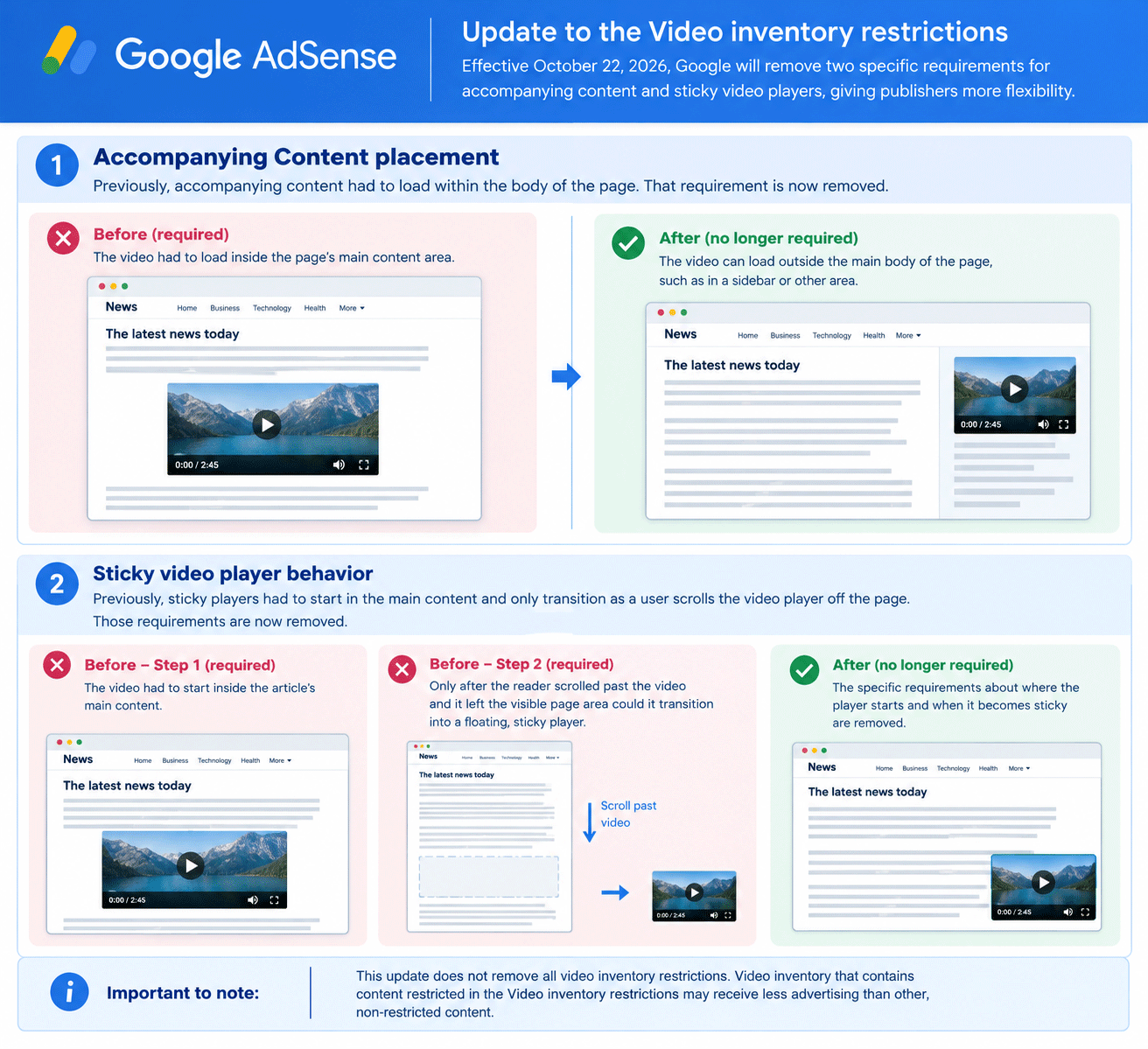
On Oct 22 Google removed the placement and sticky‑player requirements from its AdSense Video inventory restrictions. The update lets publishers position video ads anywhere on a page and keep them static, unlocking new layout possibilities that can improve user experience, increase viewability, and boost AI‑driven search visibility for local businesses.
Key Highlights
- ✓Removed placement requirement allows flexible video placement
- ✓Sticky rule eliminated for more user-friendly ads
- ✓Immediate effect for all AdSense publishers
- ✓Opportunity to boost ad revenue and AI discoverability
What Happened
Google AdSense revised its Video inventory restrictions policy on Oct 22, deleting the clause that forced in‑stream or accompanying‑content videos to start in the main content and only become sticky after the user scrolled the player off the page. The exact line removed was:
> “For In‑stream or Accompanying Content placements that transition to a sticky placement, the video player must start in the main content and only transition as a user scrolls the video player off the page.”
Key Details
- Removal of Placement Rule – Video ads can now sit in the header, sidebar, footer, or any other page area without first appearing in the main article.
- Sticky Requirement Gone – Publishers no longer need to program a sticky transition; the player may stay fixed or remain fully embedded.
- Policy Update Source – Search Engine Roundtable reported the change, which took effect immediately for all AdSense publishers.
- Impact on Monetization – The new freedom encourages experimentation with layouts that could raise viewability and click‑through rates.
What It Means For Your Business
Local and small businesses that depend on AdSense revenue or use video ads for brand awareness now have more creative latitude. You can:
- Experiment with Video Placement – Try sidebars, pop‑ups, or article footers to capture attention without breaching policy.
- Improve User Experience – Removing sticky constraints lets you craft a smoother viewing flow that keeps visitors engaged longer.
- Increase Ad Revenue – Better placement and higher viewability often translate into more impressions and higher earnings.
- Enhance AI Discoverability – As AI tools scrape sites for recommendations, a well‑positioned video can improve visibility in AI‑driven search results.
Practical Tips
1. Test Different Layouts – Run A/B tests to identify which placement drives the most engagement.
2. Keep Mobile in Mind – Ensure videos are responsive; mobile traffic typically accounts for the majority of visitors.
3. Follow General AdSense Rules – Even with added flexibility, avoid prohibited content and maintain a clean user experience.
SEO & AI Search Synergy
AI assistants such as ChatGPT, Perplexity, Gemini, and Google AI evaluate both human and machine signals when ranking content. A video that is easy to find and engaging can become a source for AI‑generated snippets, FAQs, and featured snippets. By positioning videos strategically, you raise the odds that AI tools surface your business in answer boxes or content recommendations.
FAQ
- Q1: Does this change affect my current AdSense account?
A1: The update applies to all active AdSense accounts immediately. No action is required, but you can start experimenting with new placements.
- Q2: Will the removal of sticky rules reduce my ad revenue?
A2: Not necessarily. While sticky ads can be highly visible, flexible placements often improve user experience and can boost CTRs, potentially increasing revenue.
- Q3: How do I ensure my videos comply with the new policy?
A3: Keep videos within the standard AdSense guidelines—avoid prohibited content, limit autoplay, and provide a clear call‑to‑action.
Conclusion
Google’s decision to drop the video placement and sticky requirements gives local businesses a chance to rethink how they showcase video content. Leveraging this flexibility can lead to a more engaging site, higher ad revenue, and stronger visibility in AI‑driven search tools.
Why It Matters
For local businesses, AI‑driven search is fast becoming a primary customer‑acquisition channel. Tools like ChatGPT, Gemini, and Google AI pull from a mix of text, images, and video when generating answers. When a video is positioned where users naturally encounter it—and complies with the relaxed AdSense rules—it becomes a strong relevance signal for these AI engines. That signal can push your content into answer boxes, featured snippets, or even the AI’s knowledge graph, driving organic traffic that often converts into inquiries and sales.
Beyond traffic, the removal of placement and sticky constraints lets you design a smoother user journey that keeps visitors on your site longer. Extended dwell time is a proven ranking factor for both traditional search algorithms and emerging AI models. By experimenting with new layouts, you not only open the door to higher ad earnings but also improve the overall quality score of your pages, making them more attractive to AI tools that curate local‑business recommendations.
Why This Matters For Your Business
AI‑driven search platforms now rank content based on a blend of textual relevance and multimedia signals. A video that is easily discoverable and complies with AdSense’s relaxed rules can serve as a high‑quality cue for these systems, increasing the likelihood that your business appears in answer boxes, featured snippets, or recommendation feeds. This visibility translates directly into more organic traffic, higher inquiry rates, and ultimately greater sales. Moreover, the policy change frees you to craft a user experience that encourages longer site visits. Longer dwell times boost traditional SEO metrics and are also valued by AI models that prioritize content that keeps users engaged. By testing new video placements, you can simultaneously improve ad performance and strengthen the overall authority of your pages in the eyes of both human users and AI search engines.
Frequently Asked Questions
Does this change affect my current AdSense account?
The update applies to all active AdSense accounts immediately. No action is required, but you can start experimenting with new placements.
Will the removal of sticky rules reduce my ad revenue?
Not necessarily. While sticky ads can be high‑visibility, flexible placements often improve user experience and can boost CTRs, potentially increasing revenue.
How do I ensure my videos comply with the new policy?
Keep videos within the standard AdSense policies—no prohibited content, no excessive autoplay, and maintain a clear call‑to‑action.
Is your business showing up in AI search?
Get your free AI visibility audit - see if ChatGPT, Perplexity, and Google AI actually recommend you.