
Home / News / Google Ads Commerce Audience Sharing: What Small Businesses Need to Know
Google Ads Commerce Audience Sharing: What Small Businesses Need to Know
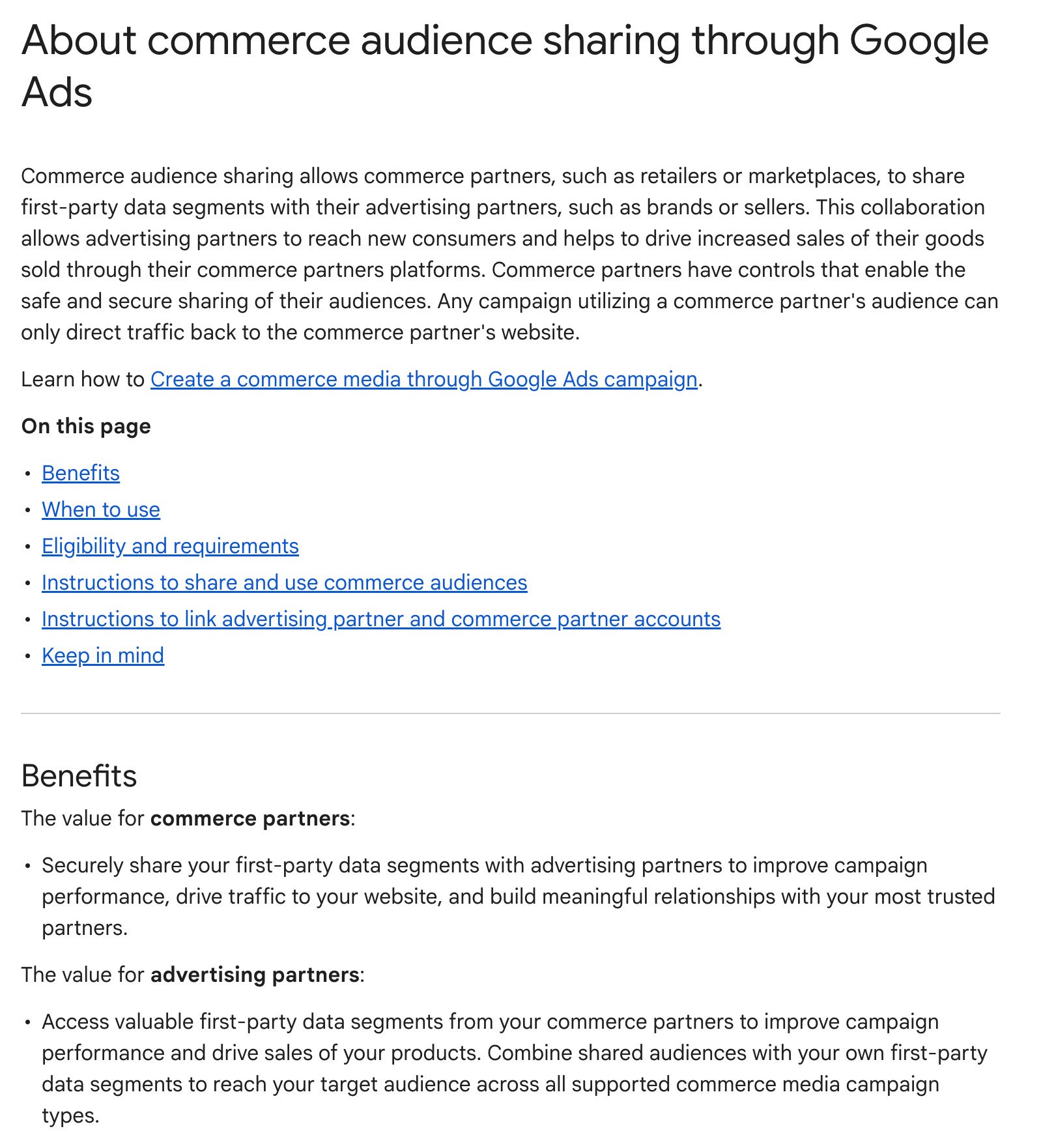
Google added a new help article titled *About commerce audience sharing through Google Ads* that explains how retailers and marketplaces can share first‑party data segments with brand advertisers. The feature lets commerce partners grant brands read‑only access to curated audiences, enabling more relevant ads while keeping data anonymous and privacy‑compliant.
Key Highlights
- ✓Commerce audience sharing lets retailers share first‑party segments with brands.
- ✓Data is anonymized, consent‑based, and compliant with GDPR/CCPA.
- ✓Partners can monetize shared audiences through revenue‑share deals.
- ✓Improved audience relevance boosts AI‑driven search and discovery.
What Happened
Google has published a new help document in the Google Ads support center called About commerce audience sharing through Google Ads. The article clarifies that Commerce audience sharing lets commerce partners—retailers, marketplaces, or even small‑business e‑commerce sites—share their first‑party data segments (such as purchase history, product interest, or loyalty lists) with advertising partners, typically brands or individual sellers. In practice, a retailer can hand a brand a pre‑qualified audience that has already shown intent to buy similar items, allowing the brand to serve more relevant ads across Google’s network.
The announcement appeared on Search Engine Roundtable under the GEO/AEO Trends category, indicating Google views the capability as a strategic step toward tighter integration of commerce data and advertising.
---
Key Details
- Who can use it? Any Google Ads‑eligible commerce partner—e‑commerce sites, brick‑and‑mortar retailers with an online presence, or marketplaces—can opt‑in to share data with approved advertising partners.
- What data is shared? First‑party segments such as:
- Past purchasers
- Product viewers
- Loyalty‑program members
- High‑value shoppers
- How is privacy handled? Google mandates compliance with GDPR, CCPA, and other privacy frameworks. Data is anonymized and aggregated, and sharing must be consent‑based.
- Where does the data go? Shared segments appear in the advertiser’s Google Ads audience library, ready for use in Search, Display, Shopping, and YouTube campaigns.
- Implementation steps:
1. Enable Commerce Audience Sharing in the Google Ads account settings.
2. Create or select first‑party segments you wish to share.
3. Invite advertising partners via email or partner ID.
4. Grant read‑only access to the selected segments.
5. Launch campaigns targeting those audiences.
- Reporting: Both parties receive performance dashboards that show impressions, clicks, and conversion lift—but never the raw personal identifiers.
---
What It Means For Your Business
1. Unlock New Revenue Streams
By sharing valuable audience data with brands, retailers can earn partnership fees or revenue‑share agreements. Brands often pay a premium for access to high‑intent shoppers, turning your data into a monetizable asset.
2. Boost Ad Relevance & ROI
When brands target audiences that have already expressed interest in similar products, ad relevance scores improve, driving lower CPCs and higher conversion rates. For local businesses, this translates into more foot traffic and online sales without inflating ad spend.
3. Strengthen AI‑Driven Discovery
Search engines and AI assistants such as ChatGPT, Perplexity, Gemini, and Google AI Overviews increasingly rely on first‑party signals to surface local businesses in answer boxes and recommendation engines. Participating in Commerce Audience Sharing signals to these models that your audience is engaged and trustworthy, helping your business appear in AI‑generated results.
4. Future‑Proof Your Marketing Stack
Google’s emphasis on privacy‑safe data collaboration aligns with upcoming regulations and the industry’s shift away from third‑party cookies. Early adopters position themselves as data‑responsible leaders, making integration with emerging AI tools and attribution platforms smoother.
---
Practical Steps to Get Started
1. Audit Your First‑Party Data – Identify high‑value segments (e.g., repeat buyers, newsletter subscribers) that you can safely share.
2. Update Privacy Policies – Secure explicit consent for data sharing and clearly disclose how partners will use the data.
3. Set Up Commerce Audience Sharing – Follow Google’s step‑by‑step guide in the new help document.
4. Reach Out to Potential Partners – Contact brands that sell complementary products and propose a data‑sharing partnership.
5. Monitor Performance – Use the shared‑audience dashboards to track lift and adjust budgets accordingly.
---
Real‑World Example
Imagine a small boutique coffee roaster in Portland that sells beans online. By sharing its “frequent buyer” segment with a local pastry brand, the roaster can earn a 10% commission on any pastry sales generated from that audience. Simultaneously, the pastry brand runs YouTube ads that showcase coffee‑pastry pairings, driving cross‑traffic to both businesses. Both partners see higher conversion rates, and the shared audience signals to AI assistants that these businesses are highly relevant to coffee‑and‑pastry enthusiasts in Portland.
---
Bottom Line
Google’s Commerce Audience Sharing is more than a technical update—it’s a strategic bridge between your first‑party data and the advertising ecosystem, with direct implications for AI‑driven discovery. Embracing it lets small businesses unlock new revenue, improve ad efficiency, and stay visible in the next generation of search.
---
Quick Takeaways
- Monetize data by partnering with brands.
- Improve ad ROI with high‑intent audiences.
- Increase AI citation chances by providing trusted signals.
- Stay compliant with privacy‑first sharing.
- Future‑proof your marketing stack ahead of a cookie‑less world.
Why It Matters: In the age of AI assistants, search results are no longer just about keywords—they’re about trusted signals that prove a business is relevant to a user’s intent. First‑party data shared through Google’s Commerce Audience Sharing acts as a powerful credibility badge that AI models like ChatGPT, Perplexity, and Google AI Overviews can reference when generating answers. When a local retailer shares a high‑value segment with a brand, that brand’s ads become more precise, leading to higher click‑through rates and more conversions. The ripple effect is that the retailer’s own online presence gains authority, making it more likely to be cited in AI‑generated snippets and recommendation lists.
For businesses trying to get discovered, this feature offers a dual advantage: it creates a new revenue channel while simultaneously feeding the AI ecosystem with clean, consent‑based data. That combination helps small businesses climb the visibility ladder without relying on costly third‑party data brokers or invasive tracking methods. In short, Commerce Audience Sharing is a strategic lever for gaining AI‑powered exposure and protecting your brand’s privacy reputation.
Why This Matters For Your Business
Commerce Audience Sharing gives businesses a concrete way to turn their own customer data into a revenue‑generating asset while keeping privacy front‑and‑center. By granting brands read‑only access to anonymized, high‑intent segments, retailers can earn partnership fees and drive cross‑traffic that boosts sales on both sides. At the same time, the shared data serves as a trusted signal for AI assistants and next‑generation search tools. Because AI models prioritize first‑party, consent‑based signals when surfacing local results, participating retailers are more likely to appear in answer boxes, recommendation lists, and voice‑assistant responses. This dual benefit—monetization plus enhanced AI visibility—makes the feature especially valuable for small and medium‑sized businesses seeking sustainable growth in an increasingly privacy‑focused digital landscape.
Frequently Asked Questions
Can a small retailer join Commerce Audience Sharing without a large advertising budget?
Yes. Enabling the feature in Google Ads is free, and you only need to share the audience segments you already own. You can start with a single brand partner and expand as results justify further collaboration.
How does Google ensure my customers' privacy when sharing data?
Google requires all shared data to be **anonymized and aggregated**, and you must obtain explicit consent from users. The platform also enforces GDPR, CCPA, and other regional privacy regulations.
Will sharing audiences affect my own ad performance?
Sharing does not diminish your own audience pools. You retain full control over how the data is used and can revoke access at any time. In many cases, the partnership improves overall performance by attracting complementary traffic.
Is your business showing up in AI search?
Get your free AI visibility audit - see if ChatGPT, Perplexity, and Google AI actually recommend you.