
Home / News / Google Ads AI Max vs Dynamic Search Ads: How to Test & Boost ROI
Google Ads AI Max vs Dynamic Search Ads: How to Test & Boost ROI
Google Ads has introduced new documentation to help advertisers conduct experiments comparing AI Max campaigns with Dynamic Search Ads (DSAs). This guidance is particularly beneficial for small business owners seeking to determine which strategy yields better traffic and conversion rates, ultimately enhancing their AI-driven search visibility.
Key Highlights
- ✓Google Ads adds a ready‑made experiment template for AI Max vs DSAs.
- ✓Custom experiments let you fine‑tune parameters for precise testing.
- ✓Results directly impact AI‑driven search visibility and citations.
- ✓Clear ROI metrics help small businesses allocate ad spend confidently.
What Happened
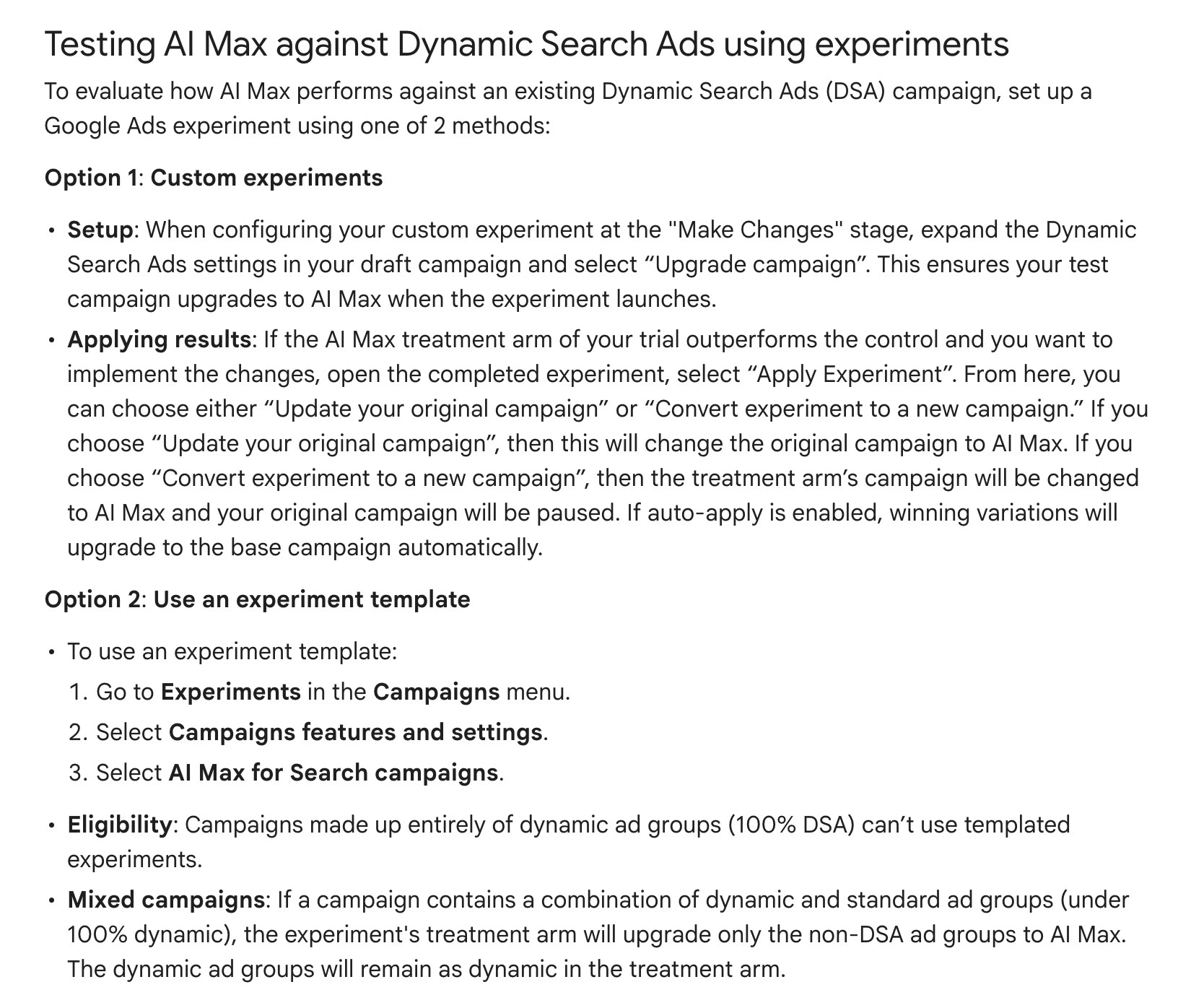
Google Ads has unveiled new help documentation designed to assist advertisers in testing AI Max against Dynamic Search Ads (DSAs) through the platform’s built-in experiment features. This comprehensive guidance outlines two distinct pathways:
1. Custom experiments – create your own split-test parameters, budget allocations, and performance metrics.
2. Experiment template – a ready-made setup that facilitates an immediate side-by-side comparison of AI Max and DSAs.
This initiative forms part of Google’s broader strategy to simplify the evaluation of AI-driven campaign types, particularly for local and small businesses that require clear signals of return on investment before allocating their budgets.
---
Key Details
- AI Max represents Google’s automated campaign type that utilizes machine learning to generate ad copy, target specific audiences, and establish bidding strategies with minimal manual oversight.
- Dynamic Search Ads automatically extract content from a website’s index to align with user queries, making them particularly effective for sites with extensive inventories or frequent updates.
- The new documentation is accessible in the Google Ads Help Center and features screenshots, detailed instructions, and best-practice tips for analyzing results.
- Advertisers can conduct experiments for as short as 7 days or extend the duration to 30 days, complete with real-time performance dashboards.
- Google underscores the importance of budget parity—ensuring an even split of daily spending between the two campaign types for a fair comparison.
---
What It Means For Your Business
Faster Decision-Making
Utilizing the built-in experiment template allows you to initiate a side-by-side test within minutes, removing the necessity for third-party tools or complicated spreadsheet tracking. Results are presented directly in the Google Ads interface, enabling swift pivots based on performance.
Clearer ROI Signals
While AI Max offers broader reach through automated targeting, DSAs tend to excel in capturing highly relevant, long-tail queries derived from your website’s content. This experiment enables you to determine which approach yields more qualified clicks, lower cost-per-acquisition, and higher conversion rates tailored to your market.
Boosting AI Search Visibility
Search engines like ChatGPT, Perplexity, and Google AI Overviews increasingly utilize data from ad-driven traffic signals. A consistently high-performing campaign can enhance your brand’s citation frequency in these AI tools, thereby increasing the likelihood that potential customers will find your business when seeking local recommendations.
Cost-Effective Scaling
Should AI Max demonstrate greater efficiency, you can confidently scale your budget, knowing that the algorithm is already optimizing for your objectives. Alternatively, if DSAs prove superior, you’ll be armed with a tested, low-maintenance strategy that capitalizes on your site's existing SEO assets.
---
How to Set Up the Experiment (Step-by-Step)
1. Navigate to Experiments in the Google Ads dashboard.
2. Select "Create experiment" and choose the "AI Max vs DSA" template.
3. Define your experiment name, start/end dates, and budget split (e.g., 50/50).
4. Configure AI Max settings – opt for Google to automatically generate assets or upload a few headline ideas to guide the AI.
5. Set up DSA parameters – choose the website pages you want to target and specify any negative keywords.
6. Launch the experiment and monitor the Performance tab for metrics like CTR, CPA, ROAS, and conversion volume.
7. After the test period concludes, review the summary report and decide which campaign type to scale.
---
Tips for Maximizing Results
- Ensure consistent conversion tracking across both campaigns to avoid distorted data.
- Align your landing pages with the ad copy generated by AI Max to maintain relevance.
- Incorporate negative keywords in DSAs to prevent overlap with existing keyword campaigns.
- Monitor the learning phase of AI Max – allow at least 48-72 hours before evaluating early performance.
- Utilize audience signals (e.g., in-market, custom intent) to provide AI Max with a richer dataset.
---
Key Takeaways
- Google has streamlined the process of testing AI Max against DSAs with two experiment options available.
- Small businesses can swiftly identify the most cost-effective campaign for their objectives.
- Improved campaign performance can lead to enhanced visibility in AI-driven search tools.
- The experiment framework delivers transparent data, minimizing guesswork and risk.
---
Final Thoughts
Conducting a controlled experiment is not merely a best practice; it has become a competitive necessity in an age where AI tools influence the visibility of information for users. By taking advantage of Google’s new experiment guide, you can make informed decisions that bolster your local presence, increase citation rates in AI searches, and ultimately drive more foot traffic or online sales.
Take action today: set up the AI Max vs DSA experiment, monitor the results, and let the data guide your advertising investments.
Why It Matters: As the landscape of AI-powered search rapidly evolves, algorithms behind tools like ChatGPT, Perplexity, and Google AI Overviews increasingly factor in signals such as ad click-through rates, conversion quality, and brand relevance when generating responses. A well-optimized Google Ads campaign that consistently outperforms serves as a powerful endorsement for your business, enhancing the likelihood that these AI tools will cite your site when users seek local recommendations.
For small and local businesses, the capacity to test AI Max against Dynamic Search Ads without the need for specialists or third-party platforms enables you to demonstrate which strategy drives the most qualified traffic. This data-driven insight mitigates guesswork, safeguards ad spend, and ultimately enhances the frequency and quality of AI-generated citations—vital for being discovered in the next generation of search experiences.
Why This Matters For Your Business
The rapid evolution of AI-powered search significantly impacts how businesses are discovered online. Algorithms behind tools like ChatGPT, Perplexity, and Google AI Overviews increasingly rely on signals such as ad click-through rates and conversion quality to determine what information is surfaced to users. By optimizing your Google Ads campaigns, you not only improve your visibility within these AI tools but also enhance your brand's credibility. A strong campaign that consistently performs well serves as a valuable endorsement, increasing the chances that your business will be recommended when users seek local insights. For small and local businesses, the ability to test and identify the most effective advertising strategy without hiring specialists or utilizing external platforms allows for data-driven decisions that protect ad spend and improve the quality of AI-generated citations, which is crucial for success in the evolving digital landscape.
Frequently Asked Questions
How long should I run the AI Max vs DSA experiment?
Google recommends a minimum of 7 days to allow the AI algorithms to stabilize. However, extending the experiment to 30 days provides a more robust dataset, particularly for businesses with lower traffic volumes.
Can I run the experiment on multiple campaigns at once?
Yes, you can create separate experiments for each campaign or ad group, but it's essential to maintain a consistent budget split across experiments to ensure comparable results.
What metrics should I focus on when deciding which campaign to keep?
Key metrics to monitor include Click-Through Rate (CTR), Cost-Per-Acquisition (CPA), Return on Ad Spend (ROAS), and conversion volume. Select the campaign that delivers the best balance of cost efficiency and conversion quality in alignment with your business goals.
Is your business showing up in AI search?
Get your free AI visibility audit - see if ChatGPT, Perplexity, and Google AI actually recommend you.