
Home / News / Google Adds Gluten‑Free, Dairy‑Free, Halal & Kosher Tags to Business Profiles
Google Adds Gluten‑Free, Dairy‑Free, Halal & Kosher Tags to Business Profiles
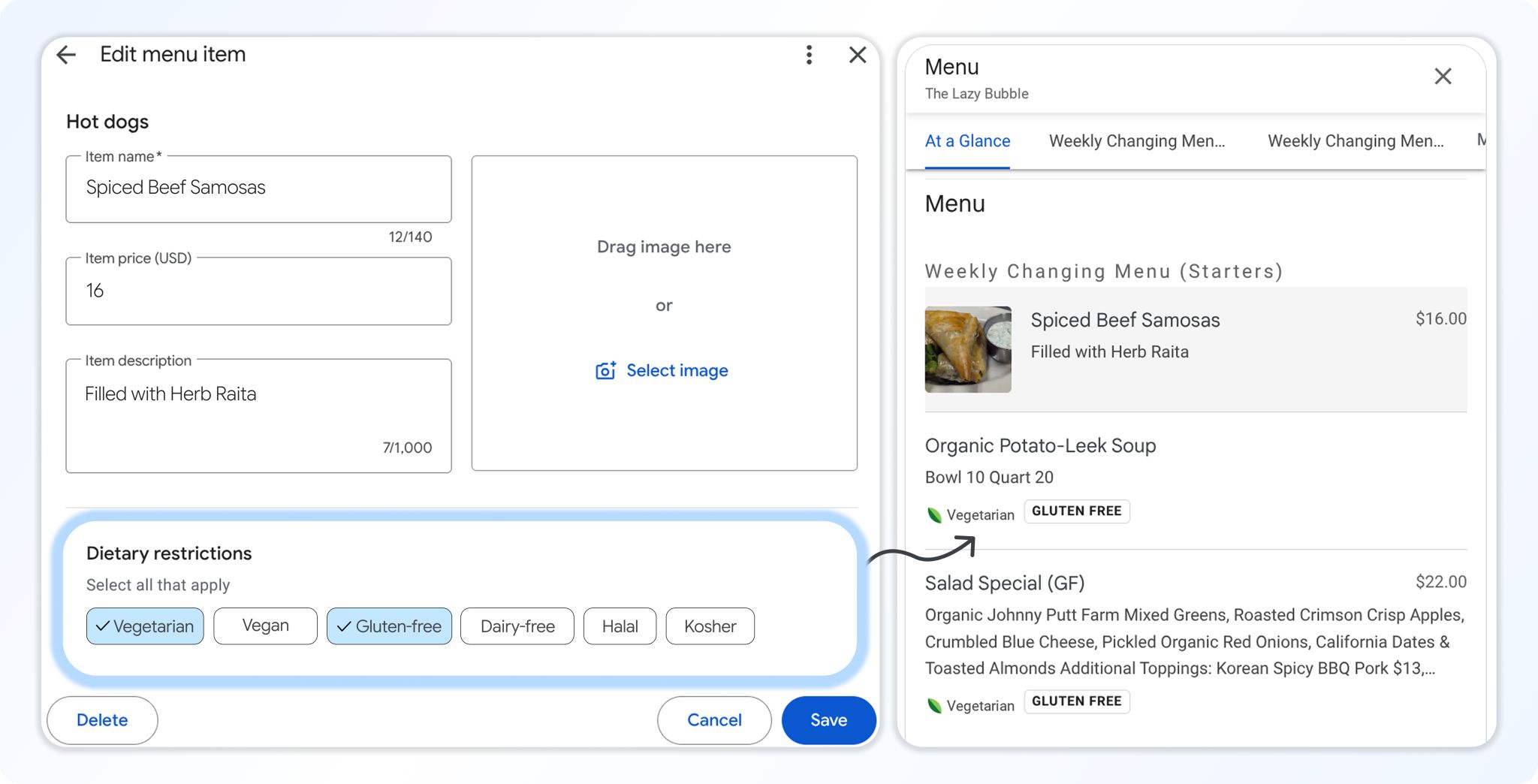
Google has expanded its Business Profile attributes to include gluten‑free, dairy‑free, halal, and kosher options, giving restaurants a new way to signal dietary offerings and boost visibility in both traditional local search and AI‑driven answer boxes. By simply checking these boxes in your profile, you can attract diners with specific needs, improve AI citations, and gain a competitive edge in crowded local markets.
Key Highlights
- ✓Google adds gluten‑free, dairy‑free, halal and kosher tags to Business Profiles.
- ✓Attributes appear in Google Maps, local packs, and AI answer boxes.
- ✓Improves AI citation chances for diet‑specific queries.
- ✓Simple dashboard edit; no third‑party verification required.
# New Google Local Dietary Attributes: Gluten‑Free, Dairy‑Free, Halal & Kosher
Oct 13, 2026 – 7:11 am
by [Barry Schwartz](https://www.seroundtable.com/author/barry-schwartz/2.html)
[Barry Schwartz / Executive Editor](https://www.seroundtable.com/author/barry-schwartz/2.html)

Barry Schwartz is the CEO of [RustyBrick](http://www.rustybrick.com/), a New York‑based web‑services firm that helps companies cut costs and boost sales through custom online solutions. He founded the [Search Engine Roundtable](https://www.seroundtable.com/) and serves as the News Editor of [Search Engine Land](http://searchengineland.com/). Known for his deep expertise in search marketing, Barry offers consulting to seasoned SEOs and works as a search‑marketing expert witness.
---
What Happened
On October 13, 2026, Google announced a major update to its Google Business Profiles (formerly Google My Business). In addition to the existing vegetarian and vegan tags, restaurants can now mark their menus as gluten‑free, dairy‑free, halal, and kosher. Lisa Landsman shared the news on LinkedIn, framing the change as a way to “remove friction” for diners with specific dietary needs. The rollout starts in the United States and will reach other markets over the next few months.
Key Details
- Four new attributes: gluten‑free, dairy‑free, halal, kosher.
- Existing tags remain: vegetarian, vegan, and any future diet‑related attributes Google may add.
- Visibility: The attributes appear on Google Maps, in Google Search local packs, and within the new AI‑driven “Google AI Overview” snippets.
- Implementation: Owners edit the attributes from the Google Business Profile dashboard under the “Food & Drink” section.
- Verification: Google does not currently require third‑party certification (e.g., Rabbi validation for kosher). The onus is on the restaurant to provide accurate information.
- Impact on AI tools: ChatGPT, Perplexity, Gemini, and Google’s own AI Overviews pull structured data from GMB, so the new fields become part of the knowledge graph used to answer diet‑specific queries.
What It Means For Your Business
1. Higher Visibility in Local Search
When a user types “gluten‑free pizza near me” or “kosher restaurant downtown,” Google’s algorithm now has a dedicated signal to match against. Restaurants that correctly tag their menus can appear higher in the Google Local Pack, Google Maps, and the AI‑generated answer boxes that are increasingly featured at the top of search results.
2. Better AI Citations
AI assistants (ChatGPT, Perplexence, Gemini) rely on structured data to generate citations. By populating the new dietary attributes, you increase the chances that these assistants will cite your establishment when answering diet‑related questions. This translates into organic AI traffic that bypasses traditional ad spend.
3. Trust Signals for Diners
Even without third‑party verification, the presence of a clear dietary label signals transparency. Customers with allergies or religious restrictions are more likely to click on a listing that explicitly states “dairy‑free” or “halal,” reducing bounce rates and increasing reservation conversions.
4. Competitive Edge
Many small eateries still list only the basic vegetarian/vegan tags. Adding the new attributes gives you a first‑mover advantage in crowded niches such as health‑focused cafés, ethnic eateries, and family‑run diners.
How to Add the New Attributes
1. Log into your Google Business Profile dashboard.
2. Navigate to Info → Add attributes → Food & Drink.
3. Check the boxes for Gluten‑free, Dairy‑free, Halal, and/or Kosher.
4. Save changes – the update typically propagates within 24‑48 hours.
5. Verify the information on your public listing and, if possible, add supporting text in the Business description (e.g., “All our salads are certified gluten‑free”).
Tips for AI‑Ready Listings
- Use consistent language: Mirror the exact attribute names (e.g., “gluten‑free”) in your website copy, menu PDFs, and schema markup.
- Add structured data: Implement JSON‑LD schema for
RestaurantwithservesCuisineandhasMenuproperties that mention the new diets. - Encourage reviews: Ask satisfied diners to mention the dietary attribute in their Google reviews (e.g., “Great gluten‑free options!”). Reviews are a strong signal for AI summarization.
- Monitor performance: Use Google Search Console and VisibilityAI’s AI‑citation dashboard to track impressions, clicks, and AI citations related to the new tags.
By treating these attributes as SEO assets, you turn a simple checkbox into a powerful discovery tool that feeds both human searchers and AI assistants.
---
Bottom line: The new dietary attributes are more than a convenience for diners; they are a fresh ranking signal for local SEO and a direct pipeline to AI‑driven search platforms. Update your profile today, optimize your website schema, and watch your restaurant climb the AI‑powered SERPs.
---
Why It Matters
For businesses that rely on local discovery, the rise of AI‑driven search tools changes the game. ChatGPT, Perplexity, Gemini, and Google’s own AI Overviews pull structured data from Google Business Profiles to generate concise, citation‑rich answers. By populating the new dietary attributes, you give these AI engines a clear, trustworthy signal that your restaurant meets specific dietary needs. This directly translates into higher visibility in AI‑generated snippets, which are now appearing at the very top of many search results—often before the traditional organic listings.
Moreover, diners with allergies or religious restrictions use very specific search phrases (e.g., “kosher brunch near me”). Without the appropriate tags, Google’s algorithm may skip your venue entirely, even if you serve those meals. Adding the attributes not only boosts human clicks but also positions your business as a reliable source for AI citation, driving traffic that bypasses paid ads and traditional SEO bottlenecks. In short, the new tags are a low‑effort, high‑return investment for any local restaurant looking to stay competitive in an AI‑first search landscape.
---
FAQs
- How long does it take for the new dietary tags to appear on Google Maps?
After you save the changes in your Google Business Profile, the updates usually propagate within 24‑48 hours, though it can sometimes take up to a week for full AI integration.
- Do I need a certification to mark my restaurant as halal or kosher?
Google currently does not require third‑party verification. It relies on the business owner’s honesty, so ensure your claim is accurate to avoid customer trust issues.
- Will adding these attributes affect my existing SEO rankings?
No negative impact is expected. Adding relevant, accurate attributes can improve local relevance and may boost rankings for diet‑specific queries.
Why This Matters For Your Business
The new dietary attributes give local restaurants a powerful signal that can be read by both traditional search engines and AI‑based answer systems. When diners search for specific meal options—such as “gluten‑free pizza near me” or “kosher brunch downtown”—Google can now match those queries directly to a restaurant that has explicitly marked its menu. This not only improves the chances of appearing in the coveted local pack, but also makes the listing eligible for AI‑generated snippets that sit at the very top of search results. For businesses, the payoff is twofold: increased organic traffic from AI assistants that cite your profile, and higher click‑through rates from diners who trust a clearly labeled menu. In an era where AI assistants are becoming the first point of contact for many consumers, these attributes represent a low‑effort, high‑return investment that keeps a restaurant visible and relevant.
Frequently Asked Questions
How long does it take for the new dietary tags to appear on Google Maps?
After you save the changes in your Google Business Profile, the updates usually propagate within 24‑48 hours, though it can sometimes take up to a week for full AI integration.
Do I need a certification to mark my restaurant as halal or kosher?
Google currently does not require third‑party verification. It relies on the business owner’s honesty, so ensure your claim is accurate to avoid customer trust issues.
Will adding these attributes affect my existing SEO rankings?
No negative impact is expected. Adding relevant, accurate attributes can improve local relevance and may boost rankings for diet‑specific queries.
Is your business showing up in AI search?
Get your free AI visibility audit - see if ChatGPT, Perplexity, and Google AI actually recommend you.