
Home / News / Bing & Copilot Test New AI Model for Search
Bing & Copilot Test New AI Model for Search
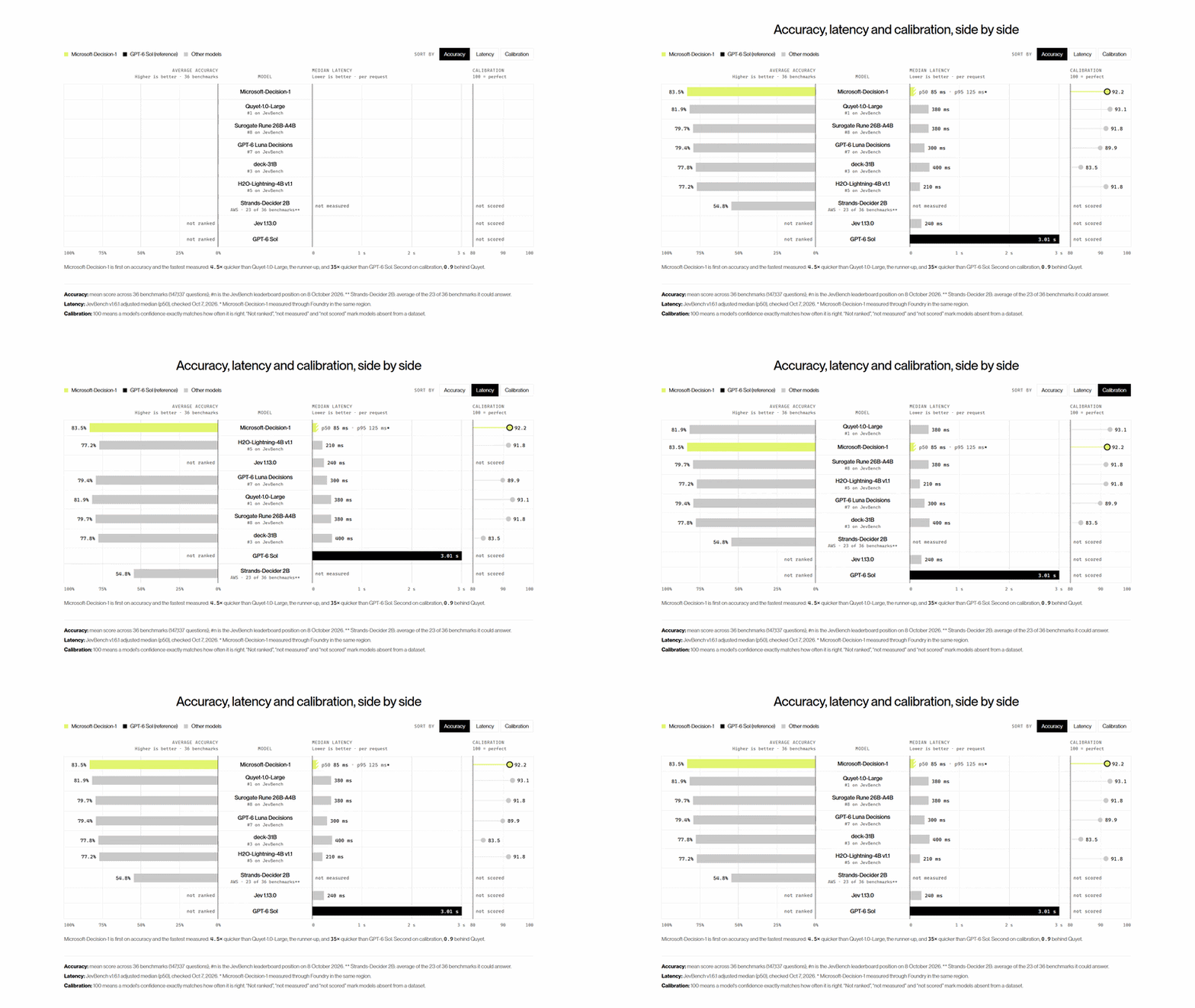
Microsoft has rolled out Microsoft-Decision-1, a new model improving how Bing and Copilot handle complex choices. This update signals a shift toward smarter AI decision-making and impacts how businesses get cited.
Key Highlights
- ✓Microsoft-Decision-1 is now live in Bing and Copilot.
- ✓It outperforms LLMs in latency and quality for structured tasks.
- ✓The model focuses on decision-making rather than just text generation.
- ✓This boosts the importance of structured, high-quality business data.
What Happened: Microsoft Launches Microsoft-Decision-1
Microsoft recently announced the rollout of a new artificial intelligence model called Microsoft-Decision-1. This innovation is already being tested in both Bing Search and Microsoft Copilot. The tech giant describes it as a "decision-scoring model" that delivers top performance in latency and quality on structured decision tasks. Crucially, Microsoft claims it outperforms both standard Large Language Models (LLMs) and other dedicated decision models.
Key Details: Understanding the New Model
To understand why this matters, we need to look at what Microsoft-Decision-1 actually does. Unlike previous models that focused heavily on generating text or creative writing, this new model specializes in decision-making.
- Structured Decision Tasks: It is designed to handle specific, structured problems where the AI needs to choose between options or rank possibilities.
- Low Latency: It processes information quickly, which is essential for real-time search results.
- Quality Over Quantity: Microsoft emphasizes that the model prioritizes high-quality outputs over just generating long streams of text.
The integration into Bing and Copilot suggests that the search engine and AI assistant are becoming better at filtering information and presenting the best options to users instantly.
What It Means For Your Business
For business owners and marketers, this update is a clear signal. As AI tools like Copilot and Bing become better at making decisions, they become more valuable to users. However, better decision-making requires better data.
When an AI can better evaluate structured data, it is more likely to cite specific, high-quality sources. This means that having accurate, structured, and authoritative business data becomes even more critical. If Copilot is using Microsoft-Decision-1 to choose the best pizza place or the best HVAC contractor, it needs to cite the sources that provide the most reliable, structured information.
This trend reinforces the need for strong Local SEO and GEO (Generative Engine Optimization) strategies. You aren't just trying to rank in a list anymore; you are trying to be the option the AI "decides" is the best choice for the user.
Why It Matters for Visibility
The shift toward decision-scoring models like Microsoft-Decision-1 changes the landscape of visibility for small businesses. Here is why you should care:
1. Citation Quality Over Quantity: With traditional search, having 100 citations might help. With decision-scoring models, the quality and structure of those citations matter more. The AI needs to see consistent data across the web to make a confident "decision."
2. Competitive Advantage: As Microsoft rolls this out, competitors who are optimized for structured data will likely appear more prominently in AI overviews. This levels the playing field for those who are tech-savvy but small.
3. Trust Signals: AI tools rely on trust. Microsoft-Decision-1 helps Bing choose the most trustworthy sources. Ensuring your business profiles are complete, verified, and detailed helps the AI trust your business over a generic competitor.
By understanding these trends, you can adjust your marketing strategy to ensure that when AI tools make decisions, your business is on the shortlist.
Why This Matters For Your Business
This matters because it represents a shift from passive information retrieval to active decision-making. As Microsoft-Decision-1 improves Bing and Copilot's ability to filter and choose the best options, the AI will rely heavily on structured, trustworthy citations. For a business trying to get found, this means that having clean, consistent, and authoritative data across the web is no longer optional—it is the primary mechanism for being selected by AI tools. If the AI cannot easily access or trust your data, it will likely choose a competitor instead.
Frequently Asked Questions
What is Microsoft-Decision-1?
It is a new decision-scoring model developed by Microsoft that outperforms other models in latency and quality for structured decision tasks. It is currently being tested in Bing Search and Copilot.
How does this affect my SEO strategy?
It emphasizes the need for high-quality, structured data. Since the AI is better at making decisions, it will prioritize businesses with authoritative, consistent citations over those with poor or inconsistent data.
Will this replace standard LLMs like GPT-4?
No, it is designed to complement them. While LLMs are great at generating text, Microsoft-Decision-1 specializes in making choices and ranking options, which is crucial for search results.
Is your business showing up in AI search?
Get your free AI visibility audit - see if ChatGPT, Perplexity, and Google AI actually recommend you.