
Home / News / AI Overviews Shrink Shopping Ad Impressions, Boost CTR – What It Means
AI Overviews Shrink Shopping Ad Impressions, Boost CTR – What It Means
Google's AI Overviews appear to be shrinking Shopping ad impressions while pushing click-through rates higher. Although that rising CTR looks positive at first glance, it often masks flat or declining store traffic. Here is what is driving this shift and how business owners can respond.
Key Highlights
- ✓Shopping ad CTRs rising while impressions fall
- ✓AI Overviews may filter low‑click queries
- ✓Higher CTR doesn’t equal better overall performance
- ✓Advertisers should track impression volume and total traffic
What Happened
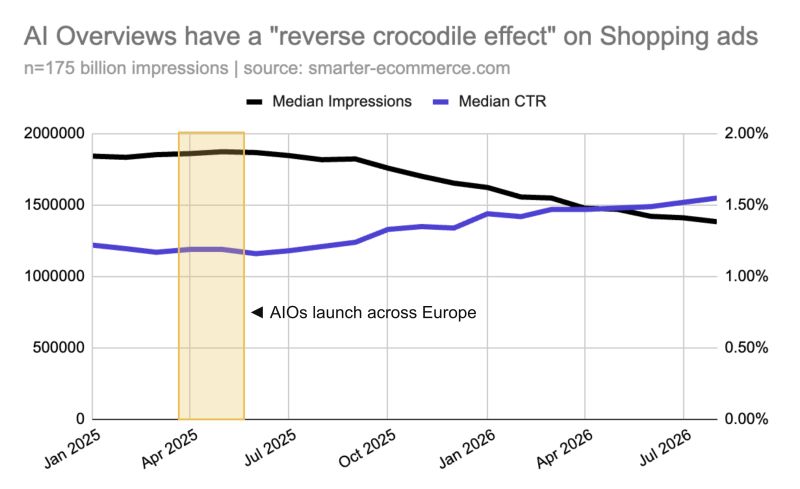
Google’s AI Overviews—the synthetic summary blocks sitting above standard search listings—are shifting how and when shoppers see paid product ads. According to an analysis by Mike Ryan, head of e‑commerce at Smarter Ecommerce, Shopping ad click-through rates (CTR) are steadily rising, yet impression counts continue to slide. This divergence suggests Google is showing Shopping ads less often, reserving them for placements where users are already more primed to click.
Ryan uncovered this trend by reviewing performance across thousands of Shopping and Performance Max campaigns representing hundreds of merchant accounts. Rather than signaling an influx of interest, the numbers told a nuanced story: total clicks held flat or dipped slightly, while impressions dropped sharply. The mathematical result is a deceptively healthy CTR.
Key Details
- AI Overviews serve low-click-propensity queries: Google appears to deploy AI Overviews on searches that rarely spark ad clicks, preserving traditional Shopping placements for searches with proven transactional intent.
- The “crocodile effect” in reverse: Content publishers face an SEO crocodile effect—expanding impressions paired with fewer clicks. Shopping ads show the exact opposite pattern: fewer impressions, but higher CTRs.
- CTR isn’t the whole story: Inflated click-through rates can easily camouflage a drop in overall search presence. When impressions dry up, gross traffic can stall even as efficiency metrics look pristine.
- Performance Max campaigns are also affected: Because this pattern spans both standard Shopping and automated Performance Max accounts, the change appears structural rather than isolated to one ad format.
What It Means For Your Business
1. Re-evaluate success metrics: Move beyond surface-level CTR. Keep a direct eye on raw impression counts, total click volume, and the total traffic landing on your store.
2. Audit your keyword strategy: Pinpoint search queries that have traded your Shopping carousels for AI Overviews. Adjust bidding strategies or refine negative keywords to reclaim lost shelf space.
3. Optimize product data feeds: High-resolution imagery, descriptive product titles, and competitive pricing help your listings compete for the limited real estate that remains.
4. Use ad extensions wisely: Incorporating sitelinks, current promotions, and price badges maximizes your visual footprint whenever an impression does clear the auction.
5. Consider alternative channels: When core Shopping impressions decline, balance your distribution through social commerce, optimized local business profiles, and direct-to-consumer outreach.
By keeping close tabs on impression depth alongside CTR, you can bypass misleading performance spikes and ensure your business remains visible to both prospective shoppers and AI discovery engines.
Key Highlights
- Shopping ad CTRs are climbing while impressions continue to fall
- AI Overviews likely absorb lower-intent, low-click search queries
- A surging CTR does not inherently mean your campaigns are delivering more customers
- Advertisers need to track raw impression depth and overall site traffic
Why It Matters
For brands navigating AI search platforms like ChatGPT, Perplexity, Gemini, and Google, digital shelf space is increasingly contested. AI Overviews now frequently command the top of the search engine results page. If your product listings get edged out on foundational queries, prospective buyers may never discover your catalog. Leaning on CTR as your primary vital sign risks creating a false sense of security while top-of-funnel reach quietly erodes.
Furthermore, generative search engines rely on consistent contextual signals across the web. When ad impressions drop, your brand forfeits valuable real-time visibility, which can dampen your prominence in AI-synthesized recommendations and citations. That downstream loss touches everything from local search positioning to organic conversion volume.
Staying competitive requires monitoring impression trends alongside conversion rates, tightening product feeds, and diversifying acquisition channels. Taking these steps ensures your business stays visible to prospective shoppers and the algorithmic engines guiding them.
FAQs
- Q1: Why is my shopping ad CTR increasing while impressions are dropping?
A1: AI Overviews are likely fielding broad, low-click search queries, concentrating your remaining Shopping ads on users with stronger purchase intent.
- Q2: Should I stop using shopping ads because of this trend?
A2: No. Instead, strengthen your feed data, adjust bid targets, and monitor gross impression and click volumes alongside CTR.
- Q3: How can I tell if AI Overviews are affecting my keywords?
A3: Review your search term reports for queries experiencing sudden impression declines, then verify whether Google is serving an AI Overview on those results pages.
Why This Matters For Your Business
For small and local businesses, AI Overviews represent a double-edged sword. While they summarize complex search topics cleanly for users, they also push commercial Shopping units out of prime screen territory on queries that previously drove consistent retail traffic. Consequently, an improving CTR can easily misrepresent business health: while each showing looks more efficient, the gross volume of consumers actually visiting your store may be dropping. Because generative engines—including Google AI, Perplexity, and Gemini—draw from active web signals to power their answers, diminished ad exposure can reduce your brand's presence across synthetic recommendations. Losing that foundational visibility weakens both local search authority and organic discovery. Protecting your market position requires auditing real impression counts rather than celebrating isolated CTR gains. By refining product feed hygiene, optimizing targeted keywords, and exploring multi-channel touchpoints, businesses can maintain relevance with prospective buyers and the AI assistants shaping their purchases.
Frequently Asked Questions
Why is my shopping ad CTR increasing while impressions are dropping?
AI Overviews are likely fielding broad, low-click search queries, concentrating your remaining Shopping ads on users with stronger purchase intent.
Should I stop using shopping ads because of this trend?
No. Instead, strengthen your feed data, adjust bid targets, and monitor gross impression and click volumes alongside CTR.
How can I tell if AI Overviews are affecting my keywords?
Review your search term reports for queries experiencing sudden impression declines, then verify whether Google is serving an AI Overview on those results pages.
Is your business showing up in AI search?
Get your free AI visibility audit - see if ChatGPT, Perplexity, and Google AI actually recommend you.